| Go to Allan's Page | Our Home Page | Holidays Home Page | British Canals Page | Go to Deb's Page |
| FlickR album of these photos | 1. Livingstone | 2: Botswana | This is Part 3 |
After the wildness of Livingstone and Chobe, the city of Cape Town came as quite a contrast! Our hotel was a typical modern city hotel, with with minimal storage space in a room which would have felt a lot bigger if it hadn't had two king-sized beds in it - at least each of the beds had a drawer on wheels underneath it, which is something we'd never seen before. We were somewhat disconcerted by the many safety warnings that were posted everywhere. For example, there were two prominent notices in out room, of which one said
- For your safety we encourage you to take precautions when leaving the hotel:
- Do not walk alone on the streets, particularly after dark
- Walk only in well-lit areas and avoid obscure alleys
- Do not invite attention by carrying cameras or wearing exposed jewellery or watches
- When using taxis, use only clearly marked taxis or those called by the hotel staff
- Store valuables, including airline tickets and passports in the provided safe
and the other one said:
- Please make use of the safe in your hotel room
- Keep cameras and other valuables close to you at all times
- At ATMs, always be alert and NEVER allow a stranger to help you, even one in uniform
- Please do not wear obvious necklaces and other jewellery in town as this can attract thieves
- Please do not walk from the hotel but make use of the free hotel shuttle bus to the Waterfront which leaves every hour on the hour from 09.00 to 21.00 hrs and returns every hour on the half hour from 09.30 to 22,30 hrs
- Please watch your handbags and hand baggage during check in and breakfast buffets
WOW we thought, what sort of city is this? Needless to say, we were very careful! The first night, however, we stayed in the hotel and sampled the food and drink at the bar (both were excellent)
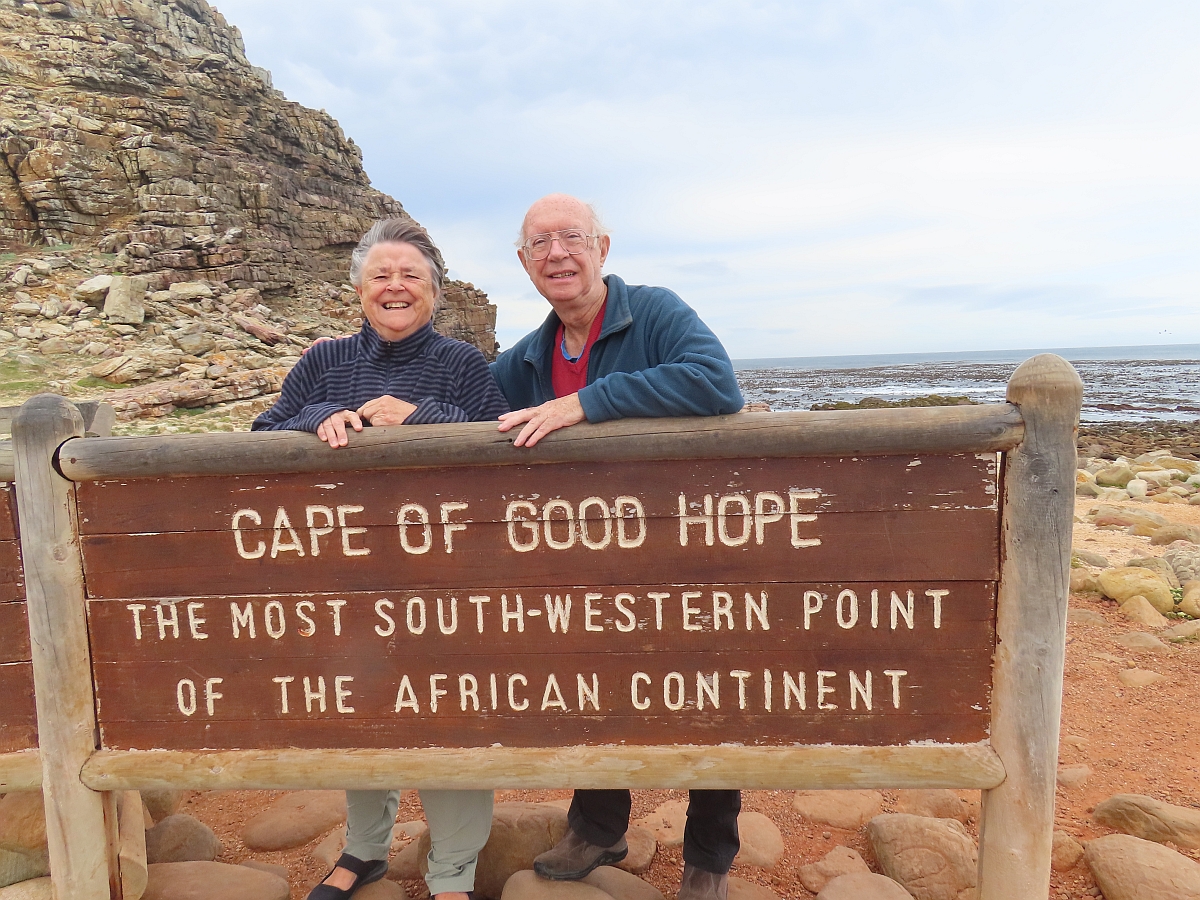
The next day we boarded a coach and set off to explore the Cape area. First we travelled along an incredible cliff-side road to the Cape of Good Hope.
For many years the Cape of Good Hope was regarded as the most southerly point of Africa, and therefore as the place where the Indian Ocean meets the Atlantic Ocean. Whilst it is true that this is the place here the waters of the two oceans meet, it is the nearby Cape Point which is actually the most southerly point that has more recently been defined as the actual meeting point of the two oceans. Personally I prefer the original definition.
 |
 |
 |
 |
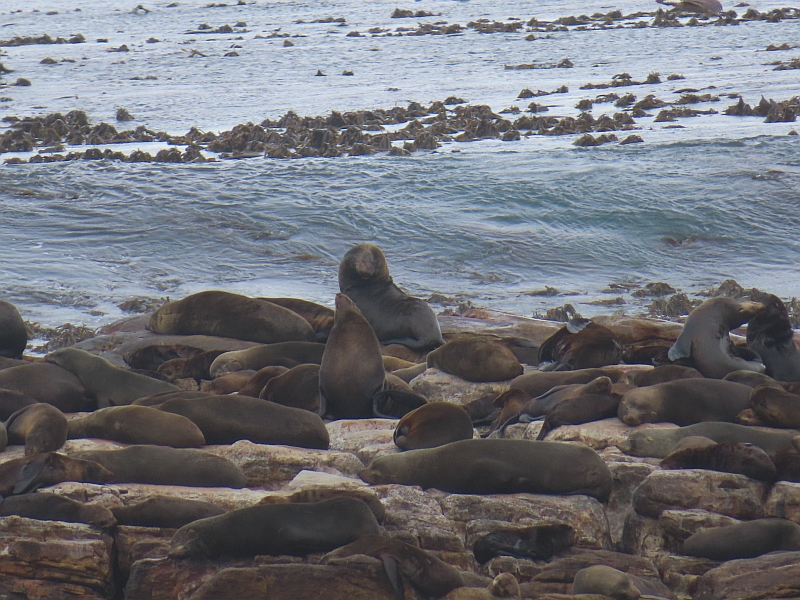
The rocks at the Cape of Good Hope were covered in sleeping seals |
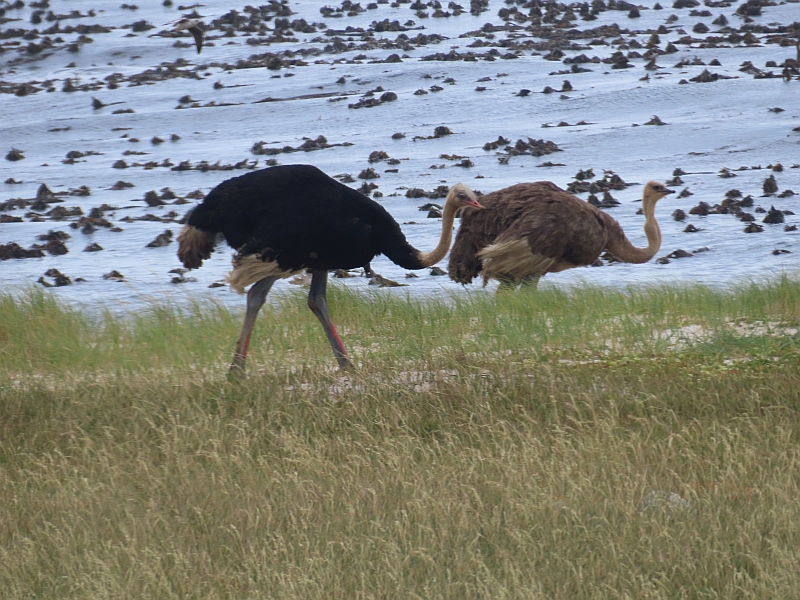
There were also ostriches wandering around the Cape |
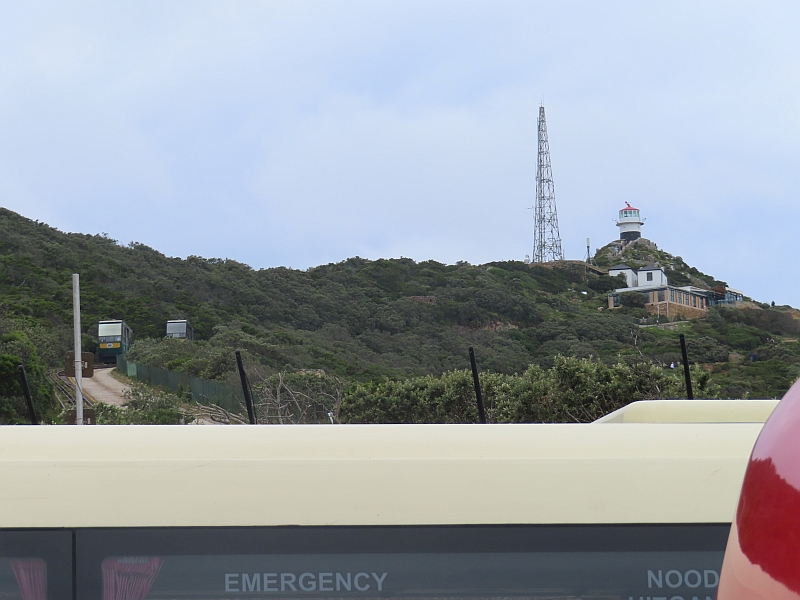
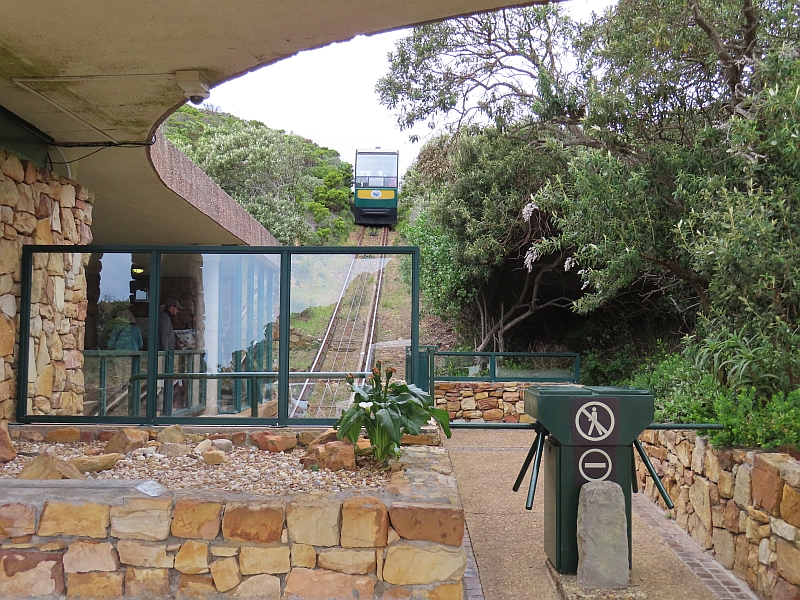
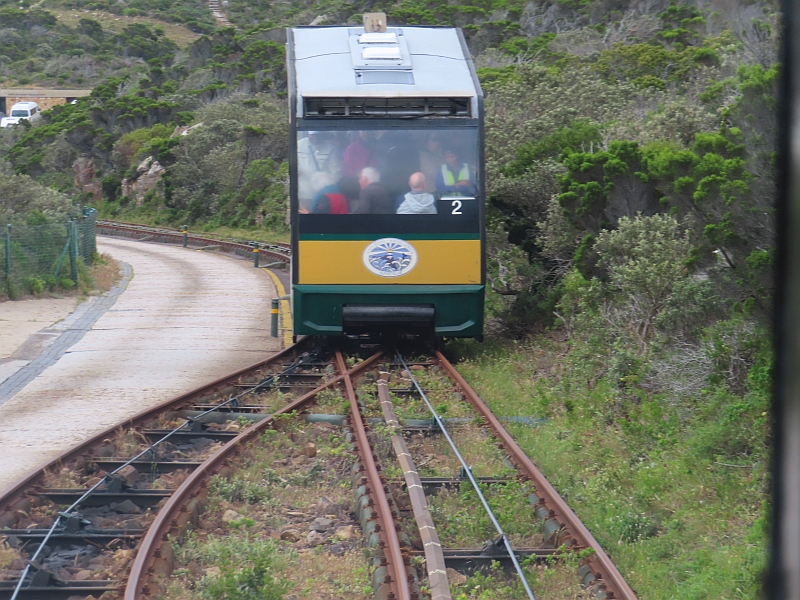
There is a funicular railway up to the lighthouse at the Cape |
Our funicular train approaches the lower station |
 |
 |
 |
 |
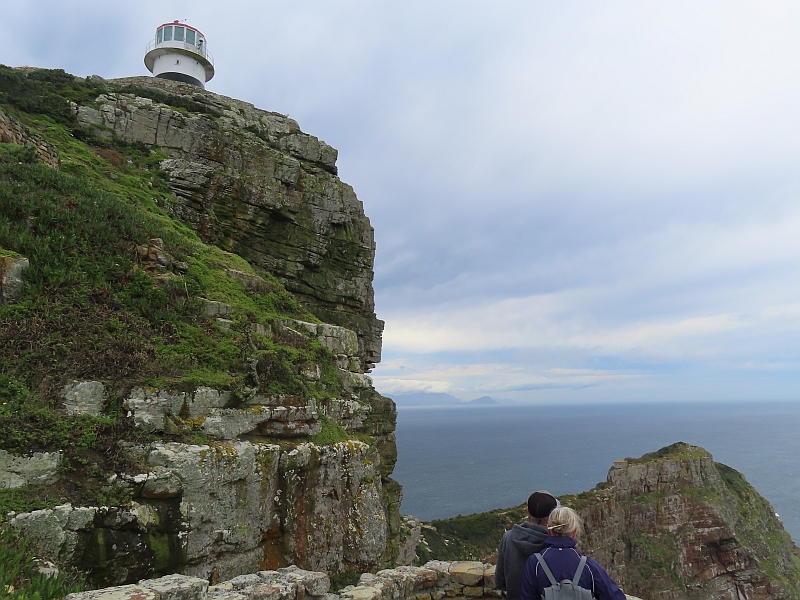
The old lighthouse at the top of the Cape; the new lighthouse is at the foot of the cliff |
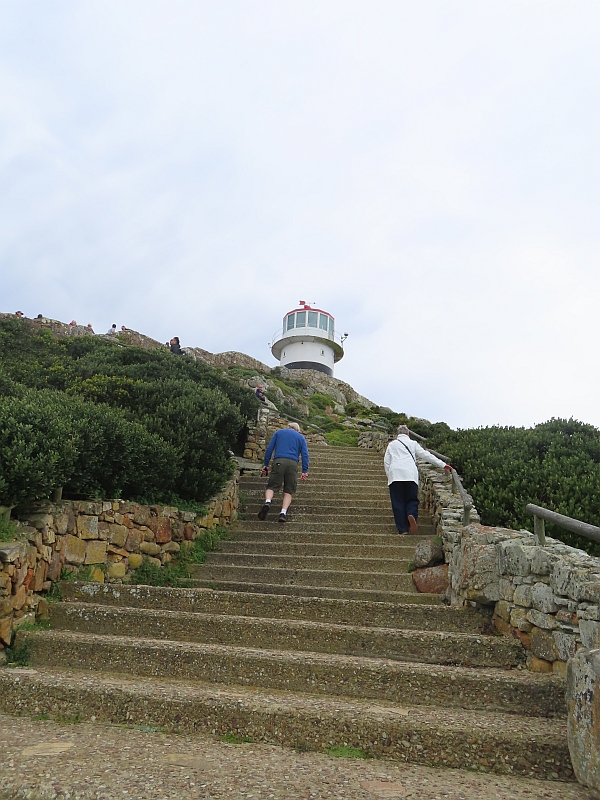
It was still a long steep climb from the top of the railway up to the lighthouse |
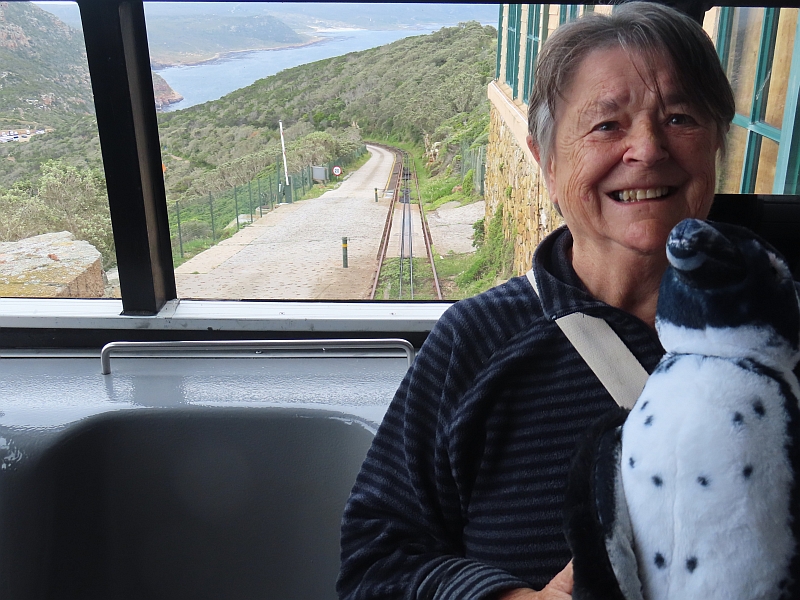
Debbie purchased a new friend to accompany her on the ride back down |
The two cars of the funicular railway meet at the half-way point. |
The Cape of Good Hope was also known as the Cape of Storms, a state of frequent weather which argued strongly in favour of there being a lighthouse at the cliff-top. However this turned out to be a bad choice, for they soon found that although the lighthouse was clearly visible from a long distance when the weather was good (and the lighthouse wasn't so necessary), the clouds descended enough to make it invisible whenever there was a storm (when the lighthouse was most needed), Eventually, after many shipwrecks had occurred, they gave up and built a new lighthouse near to the foot of the cliff - it is just visible as a small speck of white in the extreme bottom-right corner of the photo above.
After a brief visit to the Cape Point itself, we continued to a place of great excitement for Debbie: Boulder Beach, which is famous for its penguin colony. We first had a delicious seafood lunch at a beach-side restaurant, and then walked along to see the colony itself.
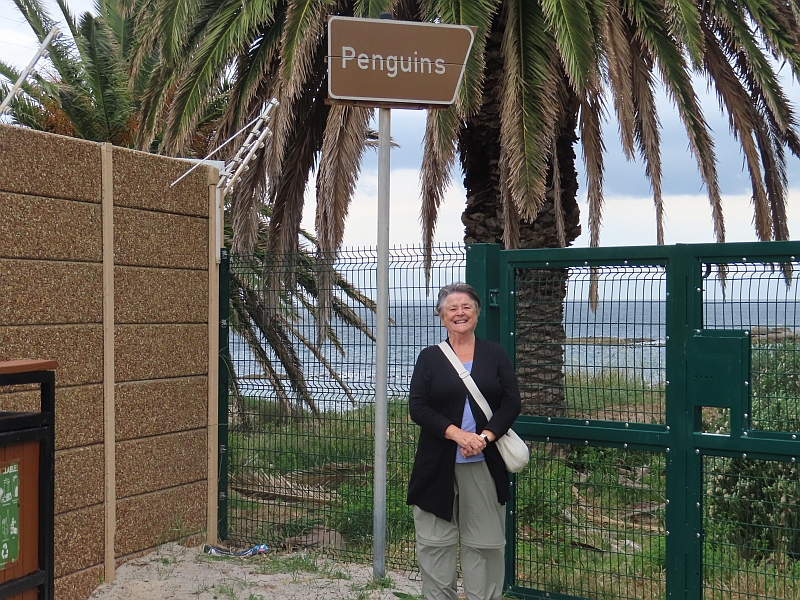
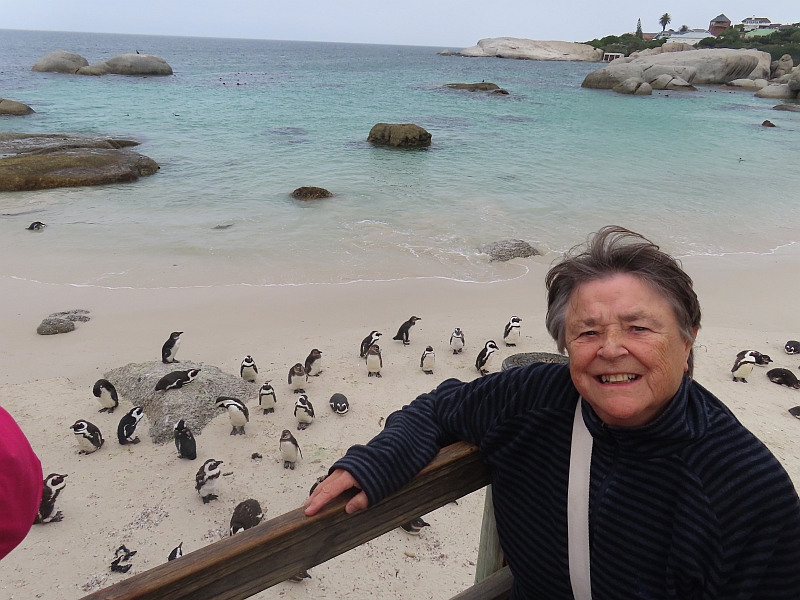
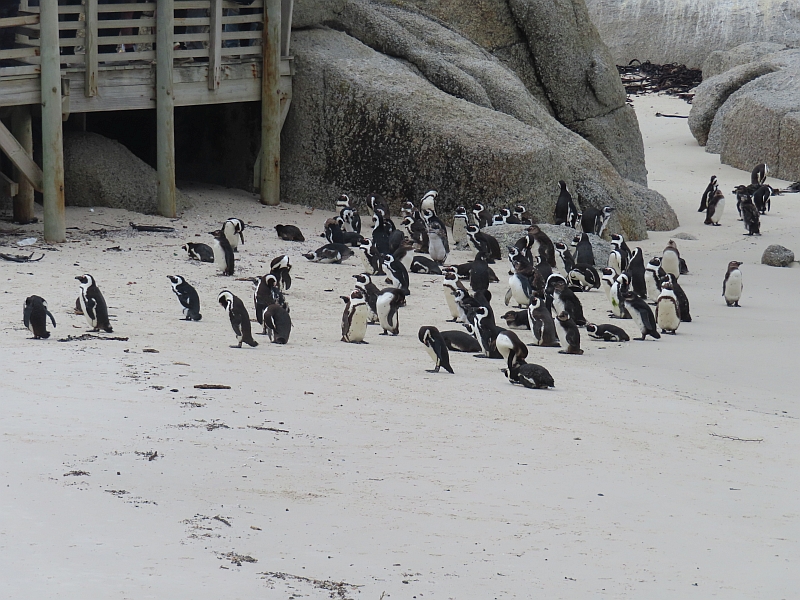
There are two raised wooden walkways down to Boulder Beach: The main one leads to a viewing platform, from which you may look closely down onto the beach full of penguins; the second, smaller one leads through the woodlands - which are populated by many lone or nesting penguins - down to the other end of the beach. Debbie was of course utterly mesmerised, not only by the sheer numbers of penguins on the beach, but also by the cuteness and closeness of the penguins in the woods.
 |
 |
 |
 |
 |
Debbie on the viewing platform |
Penguins below the viewing platform |
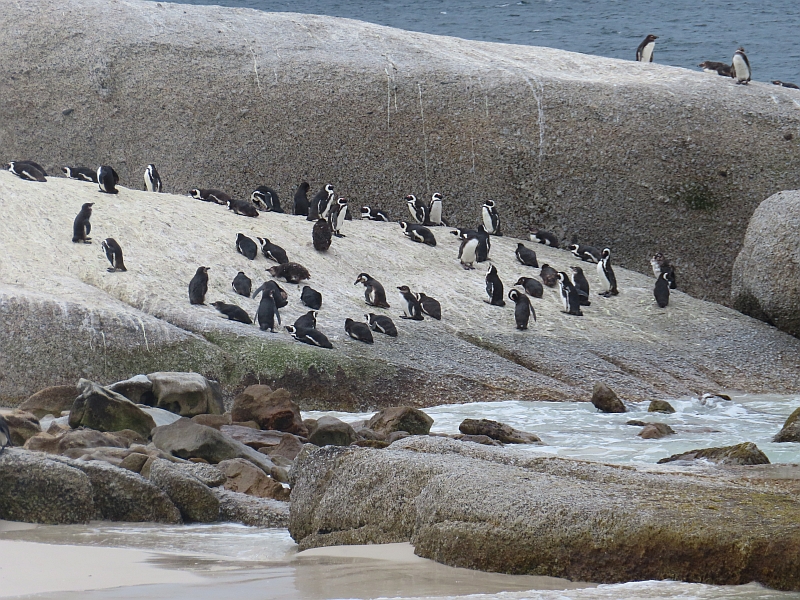
Penguins on the rocks |
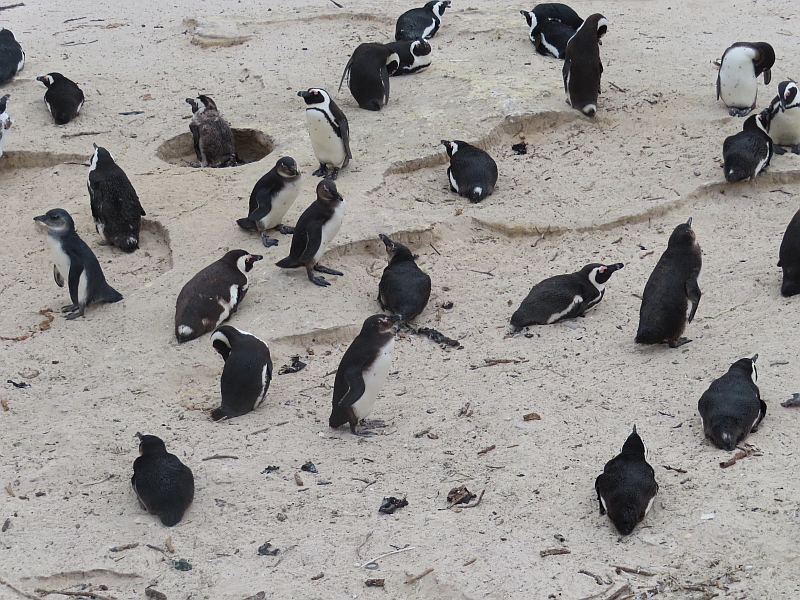
Penguins on the sand |
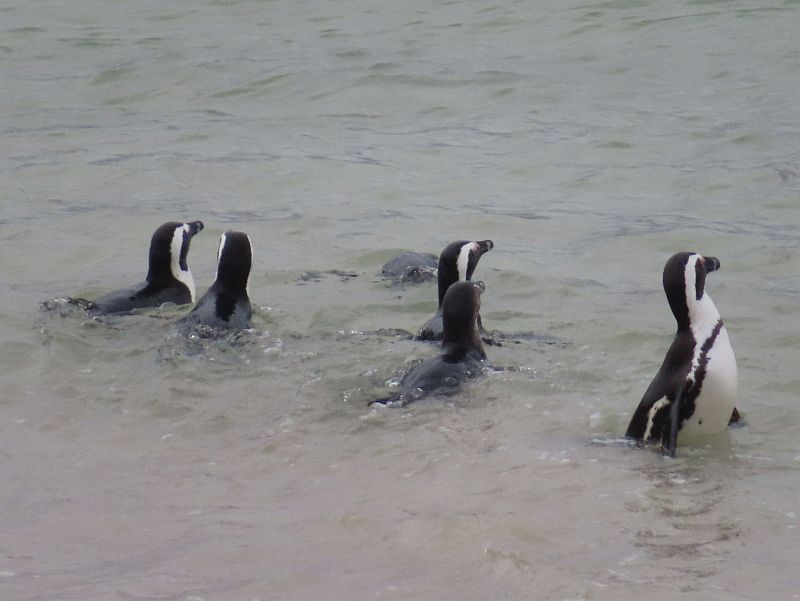
Penguins in the water |
 |
 |
 |
 |
 |
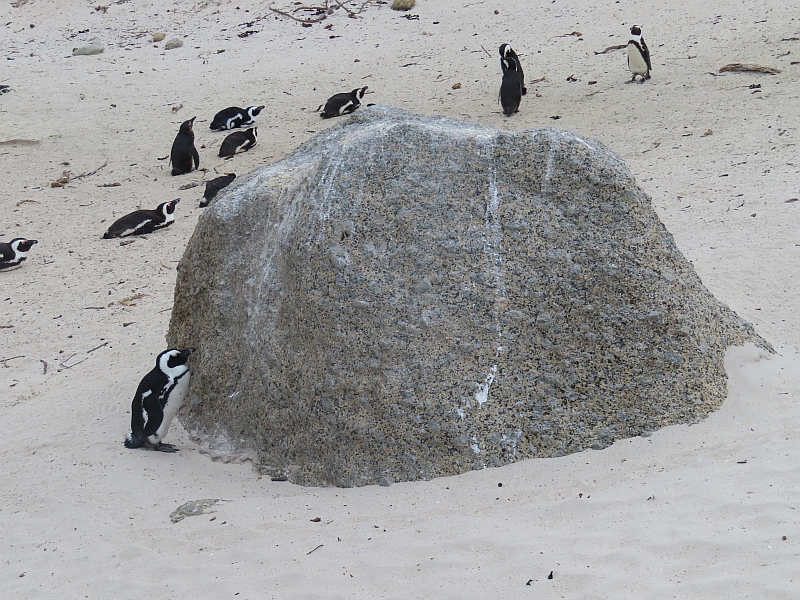
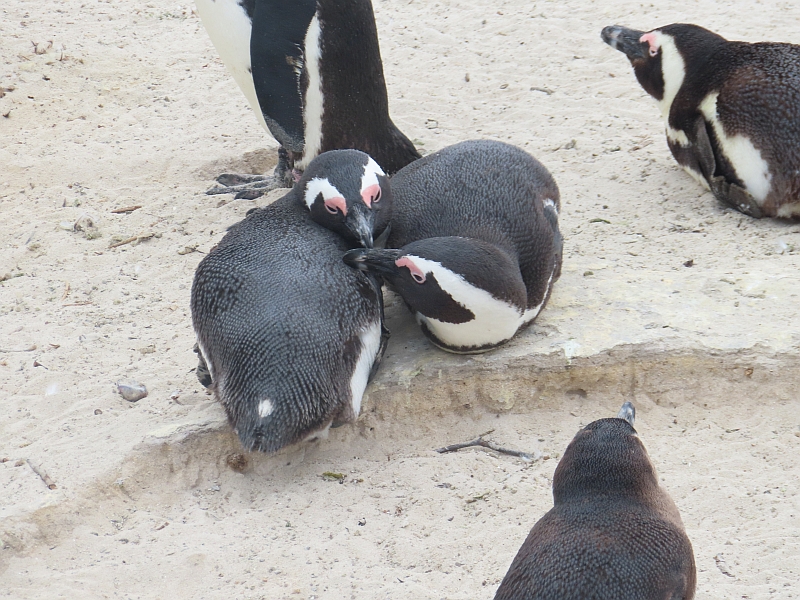
A penguin waits for the 'King of the Castle' to move his rock out of the way |
Two penguins enjoy each other's company on the beach |
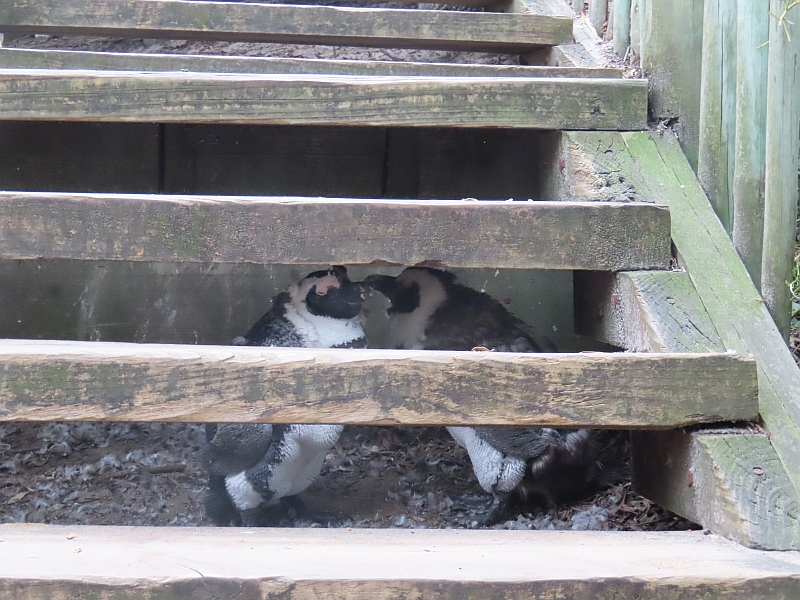
Two young penguins keep watch under the walkway steps |
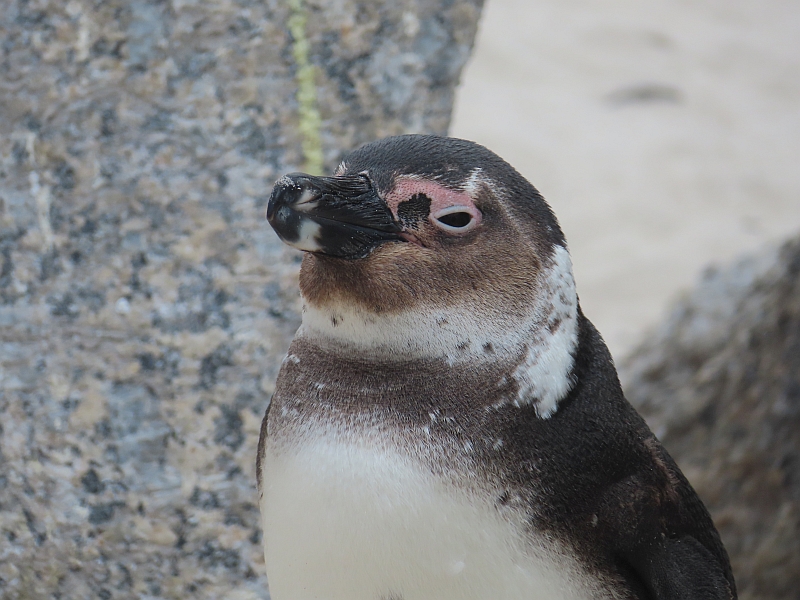
This one was very handsome |
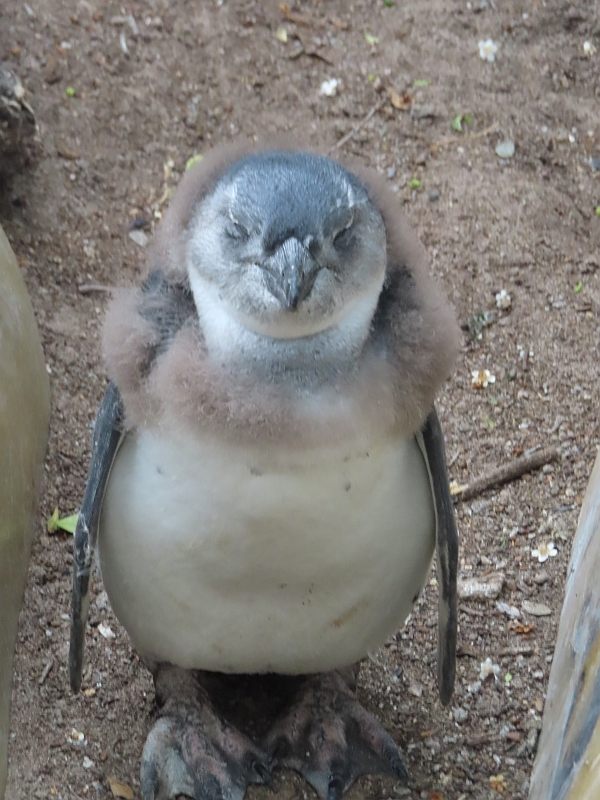
This one was rather cute |
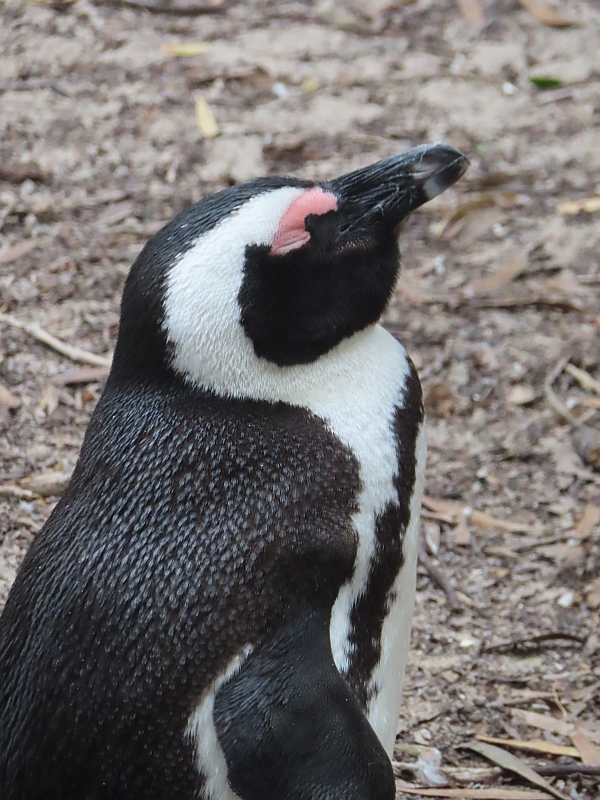
If you like these pictures of the penguins that we saw, you can see a lot more of them in my Penguin Gallery on Flickr, where they may be viewed either individually, sequentially, or as a slideshow. Alternatively, you may like to look at the pages from our Antarctic trip in 2003.
Returning to the hotel, we took the shuttle bus for a brief visit to the V&A Waterfront area (confusingly, this stands for 'Victoria and Alfred'}. The shopping mall there held little interest for us, as it was mainly full of expensive global-brand items, but it led to the main Harbour area which looked interesting and worth visiting later on when we had more time (and daylight). We took the shuttle back to the hotel, to spend another evening eating and drinking in their bar area,
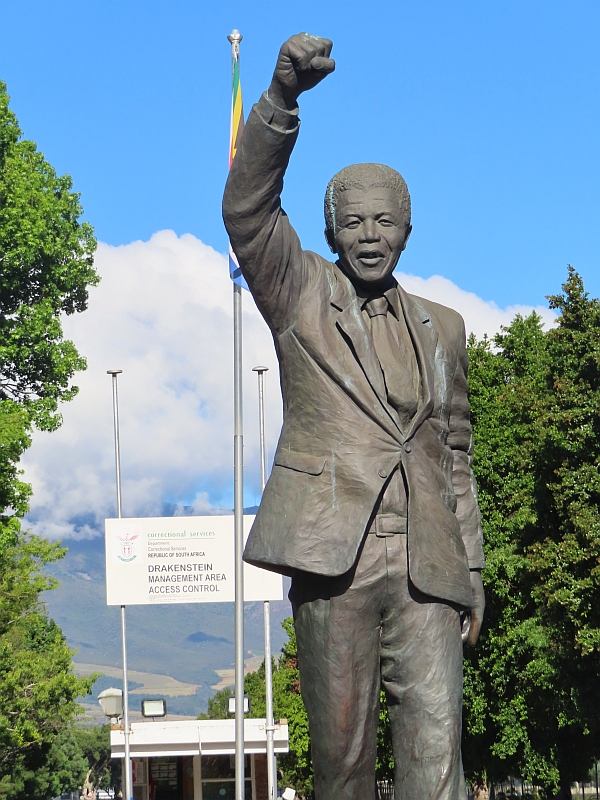
The next day's visit was to the famous wine-growing area of Stellenbosch. On the way we stopped briefly at the entrance toa prison where Nelson Mandela was held for many years, before proceeding to the small town of Franschhoek (which means the French Quarter) where, amongst other things, in their early days they learned how to make French Chocolate. We drank a couple of mugs of hot chocolate in their works; which were so delicious that we just had to visit their shop and buy ourselves some chocolate-covered honeycomb to bring home with us.
We then continued to Stellenbosch itself, where we explored the town on foot before being taken to a vineyard for a superb lunch followed by a wine tasting. We enjoyed their conventional wines, but we were not so keen on two of their rather experimental ones: one with 5 different varieties of grape, and one that had accidentally matured in a cask that was already partly filled with brandy. We were also slightly disappointed by the talk about wine-making that we were give, as the person giving the talk was clearly rather bored with doing so.
 |
 |
 |
 |
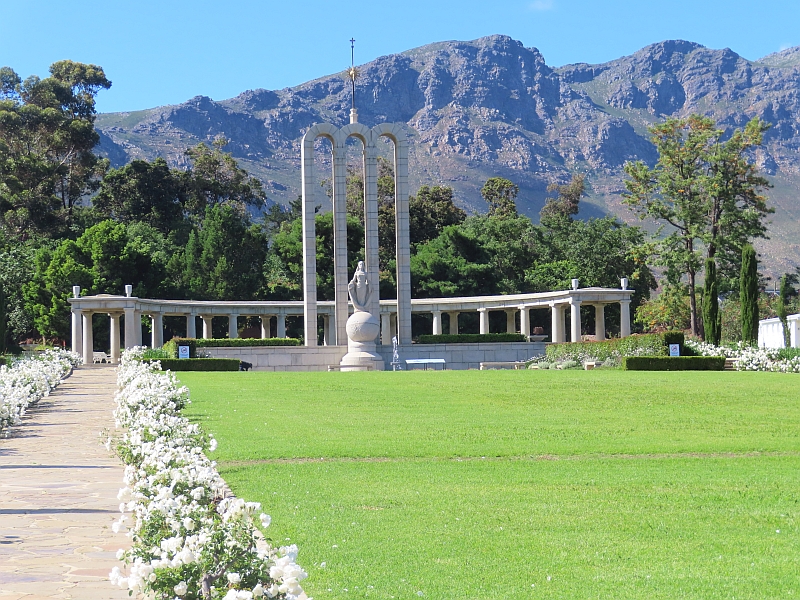
The rather beautiful Huguenot memorial in Frenschhoek |
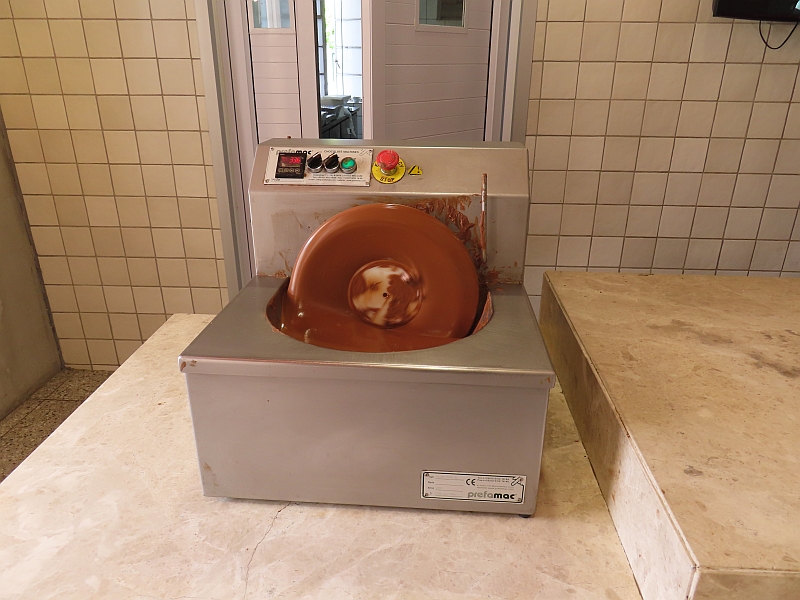
A chocolate-making machine |
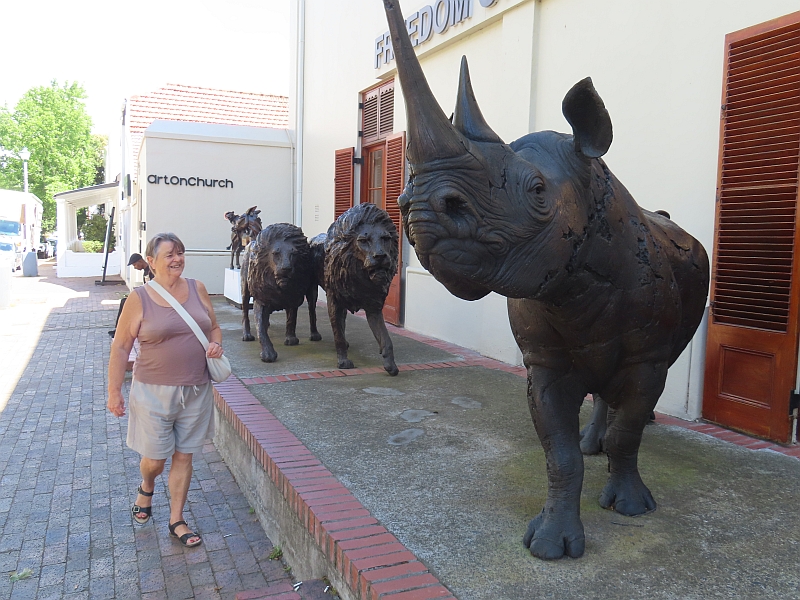
There is plenty of street art in Frenschhoek |
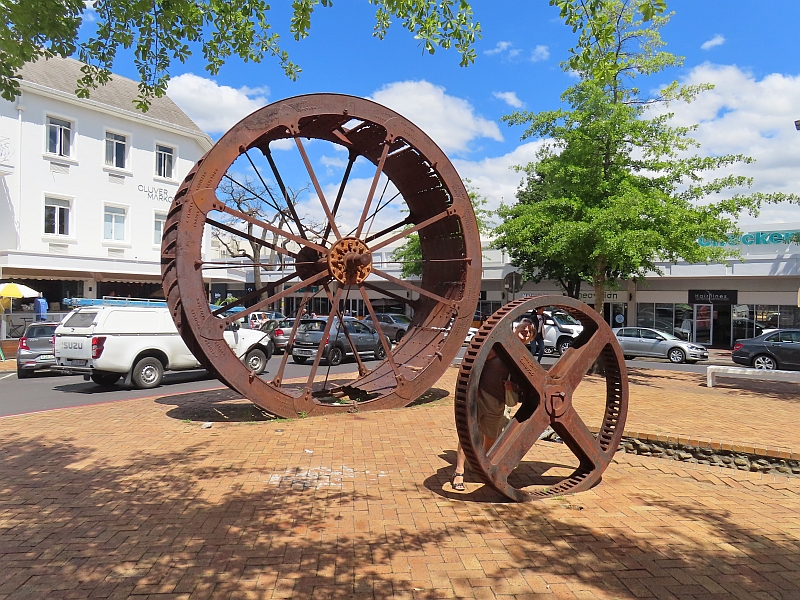
Ancient machinery serves as street art in Stellenbosch |
 |
 |
 |
 |
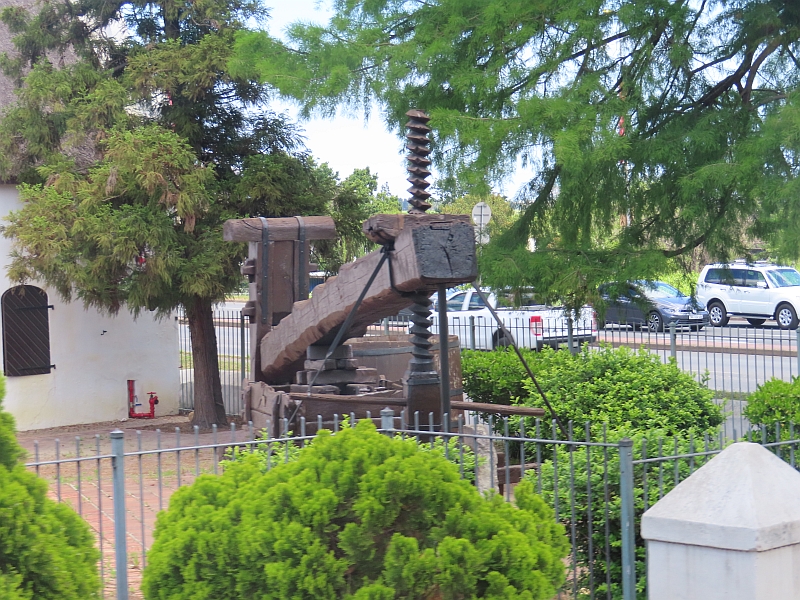
More ancient machinery in Stellenbosch |
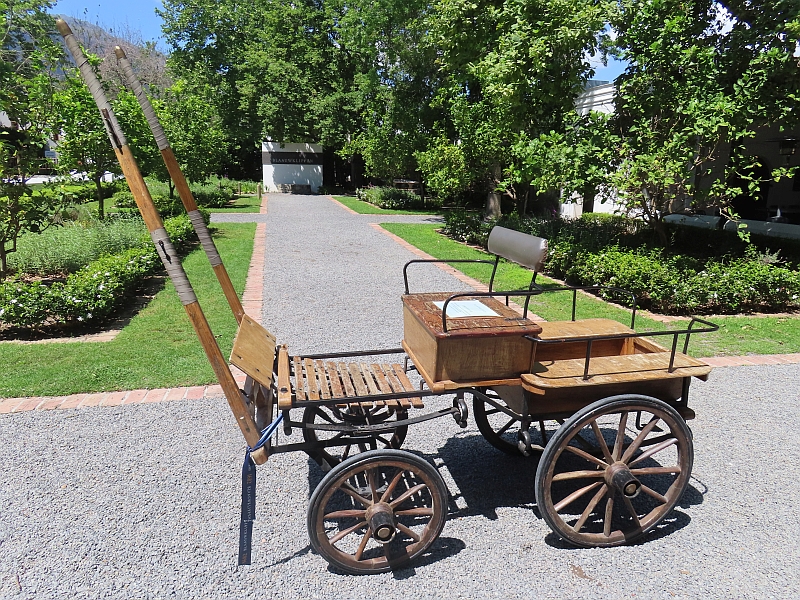
An old cart at the vineyard |
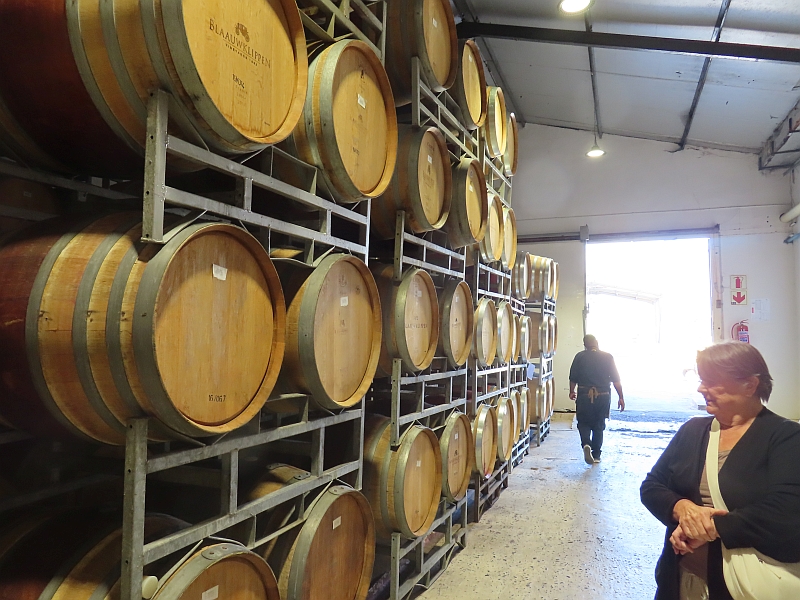
Debbie has found a few barrels of wine ... |
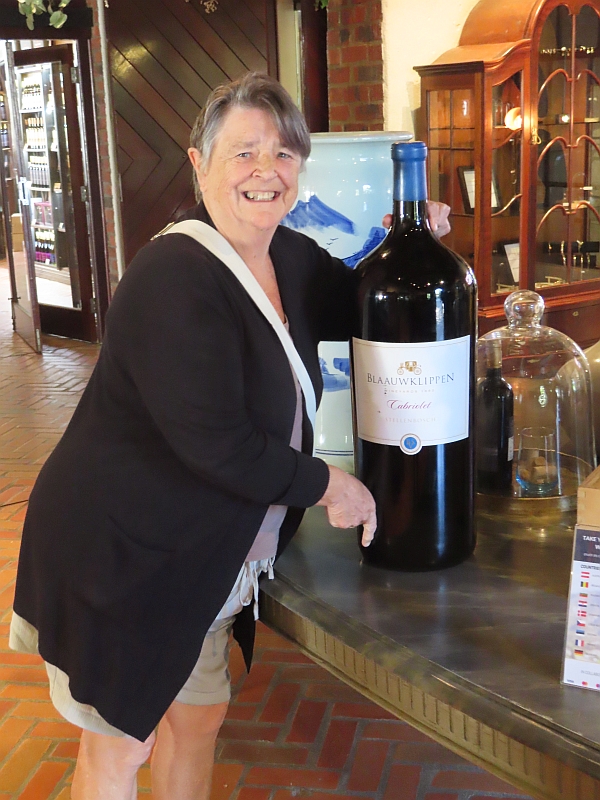
... as well as her ideal size of wine-bottle |
We returned to the hotel - still feeling very full after our lunch - and had a relaxing afternoon while we planned our activities for the next day which was free for us to do as we wished. Bearing in mind the warning signs in our room, we decided that we would start by getting the hotel staff to call us a taxi to the cable-car station at the foot of Table mountain.
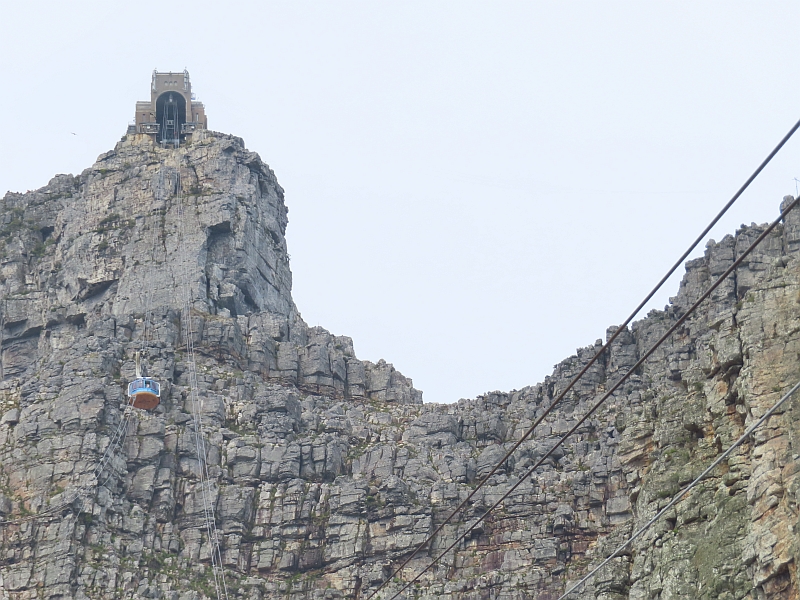
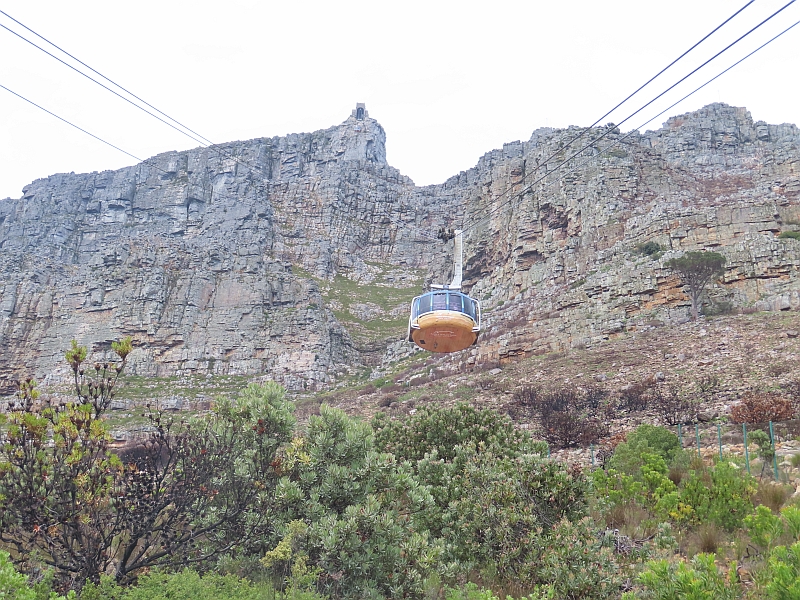
The weather was perfect for a trip to the top of table mountain (clear, dry, and not too windy) and the queue for the cabe car was only about 30 minutes (there is a website that shows you the length of the queue in real-time, as well as the weather at the summit, so that you can plan your journey there) so we asked the hotel concierge to call us a taxi. The taxi took us to the cable-car station, where we waited a short while before boarding a cable-car.
 |
 |
 |
 |
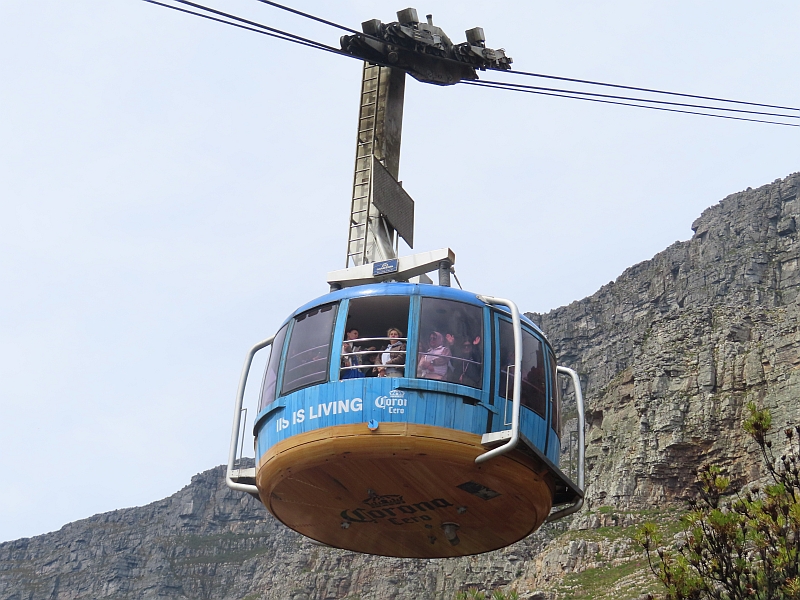
Our cable car approaches us, as we wait at the foot of the mountain |
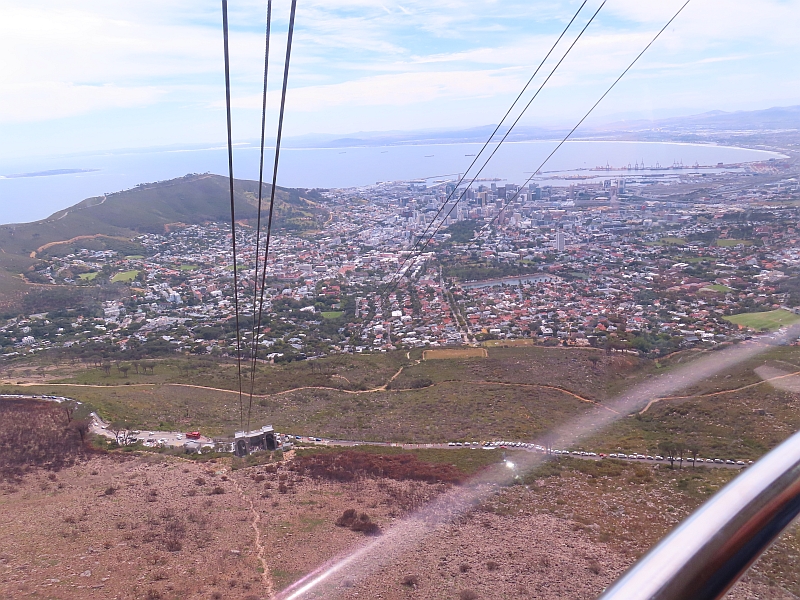
Looking down from inside the cable car |
||
 |
 |
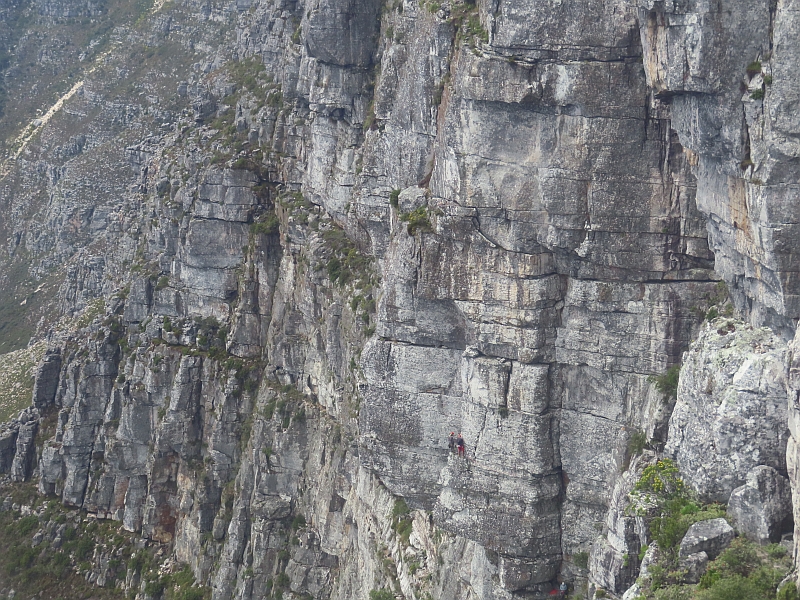 |
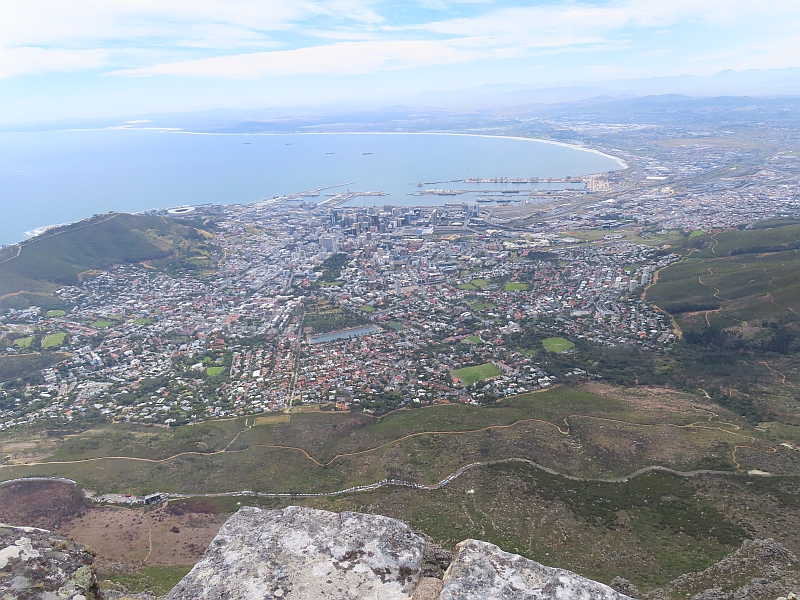 |
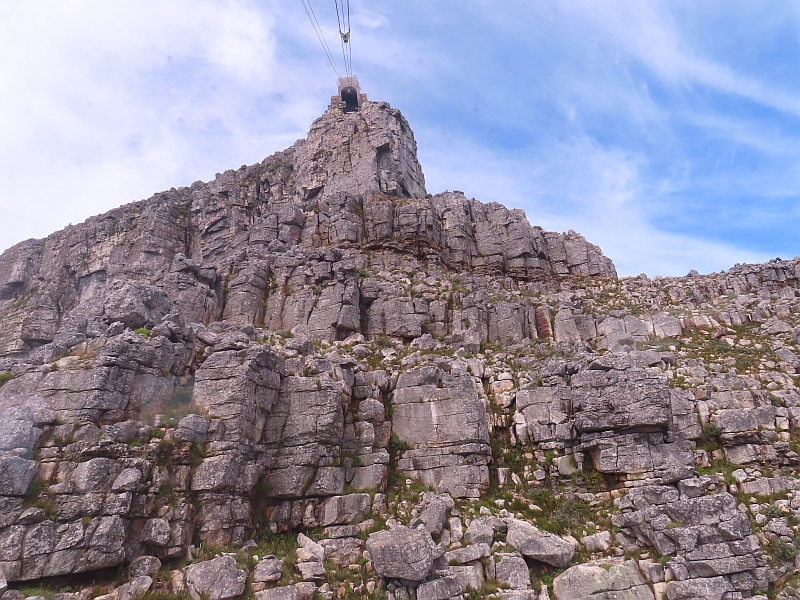
Looking up from inside the cable car |
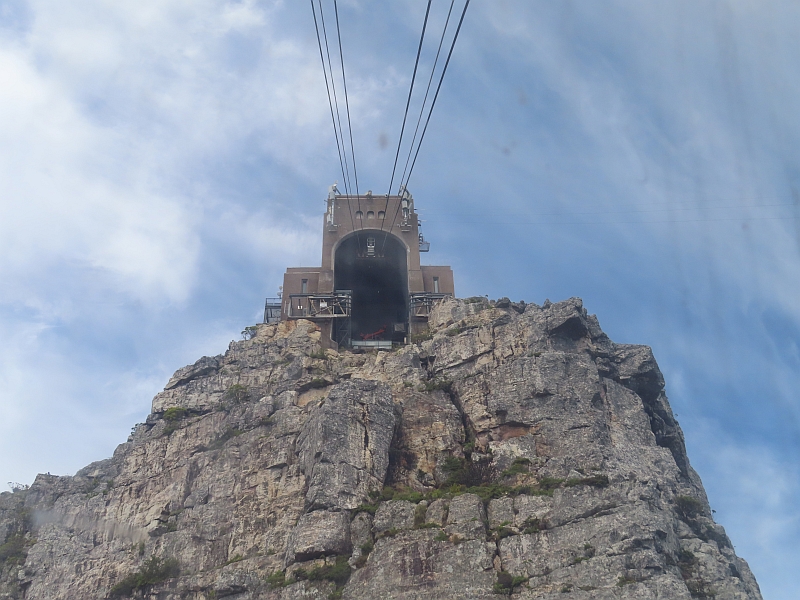
We are approaching the summit of the mountain |
Can you spot the two climbers on this cliff? |
Cape Town, seen from the summit |
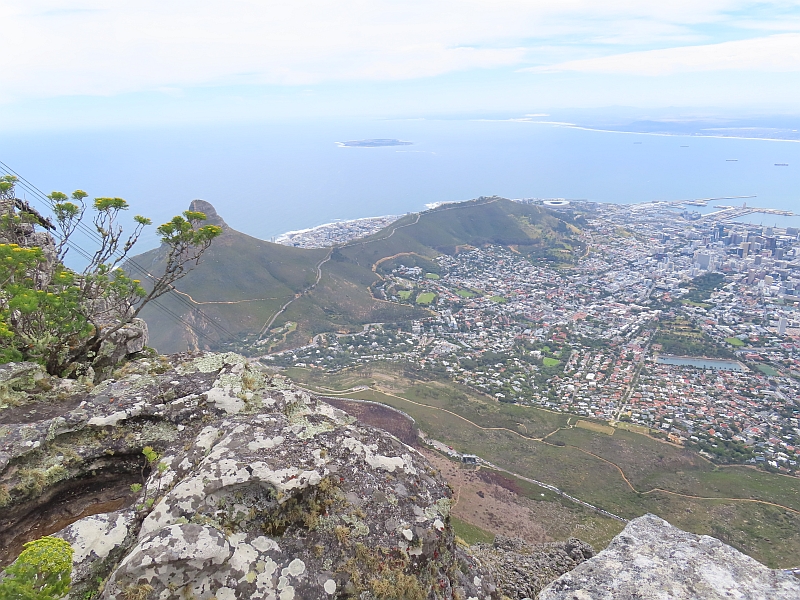 |
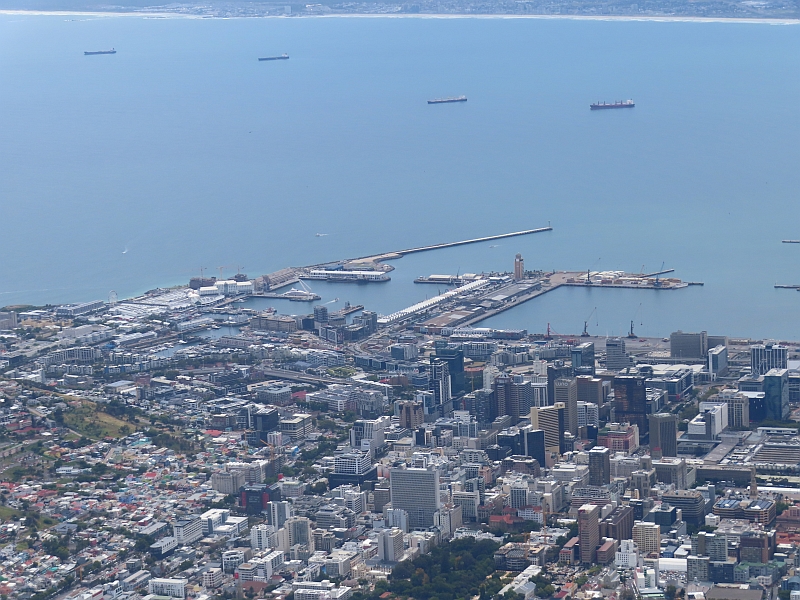 |
 |
 |
Cape Town, seen from the summit |
Cape Town, seen from the summit |
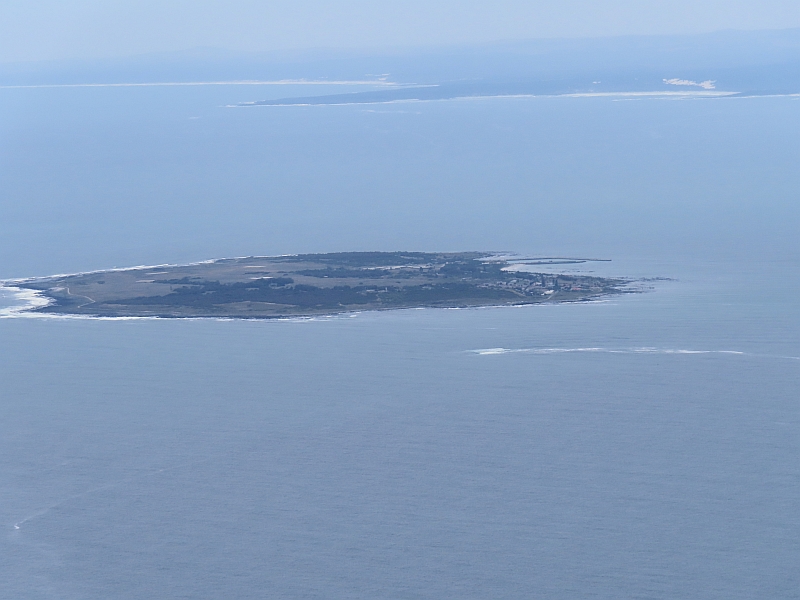
Robben Island where Mandela was imprisoned |
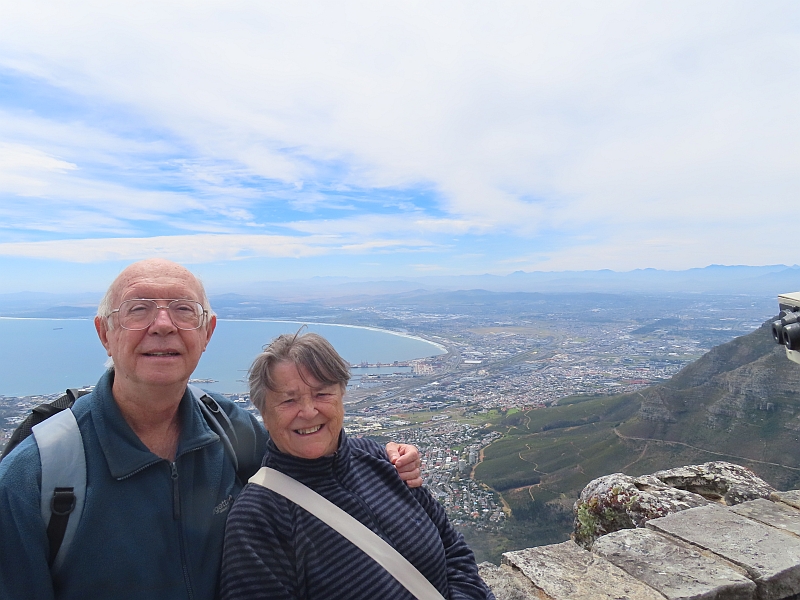
Proof that we were up at the summit |
We were extremely lucky because having had a wonderful view from the summit, while we were enjoying a cup of coffee in the summit cafe, the clouds rolled in and obscured the view for the rest of the day. Happily we boarded the cable car and returned to the base where the same taxi collected us for return to the hotel. This left us a free afternoon, so we caught the shuttle bus to the V&A Waterfront and strolled through to the Harbour area.
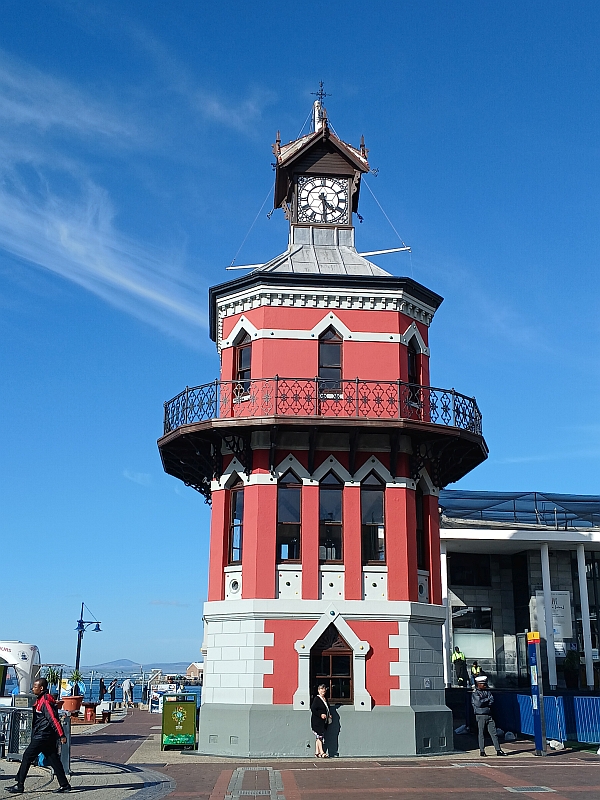
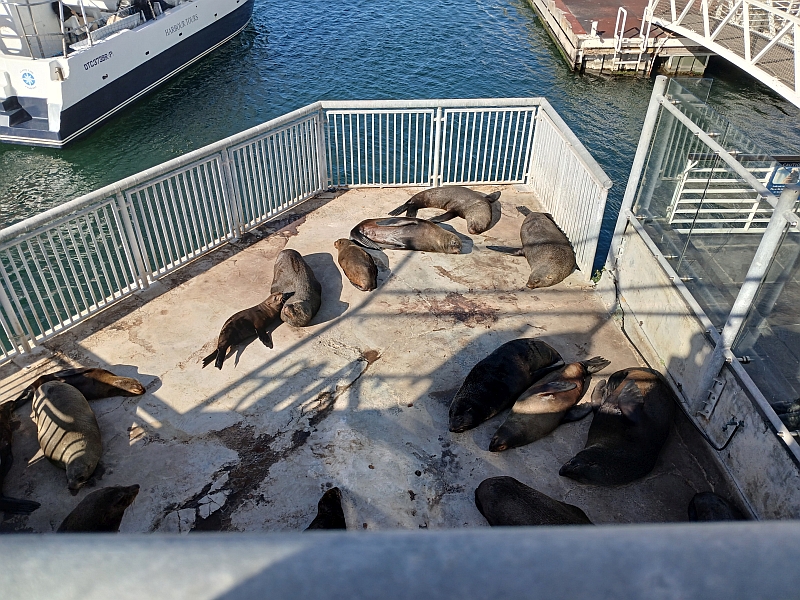
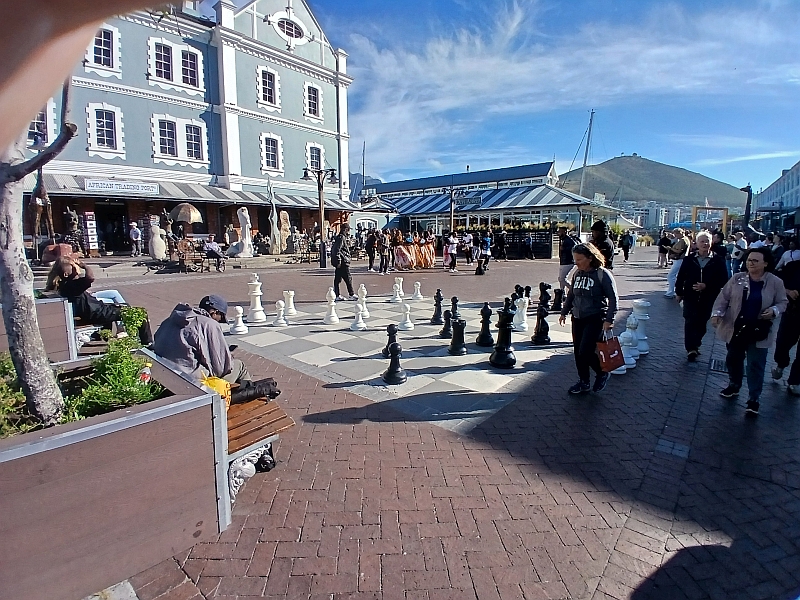
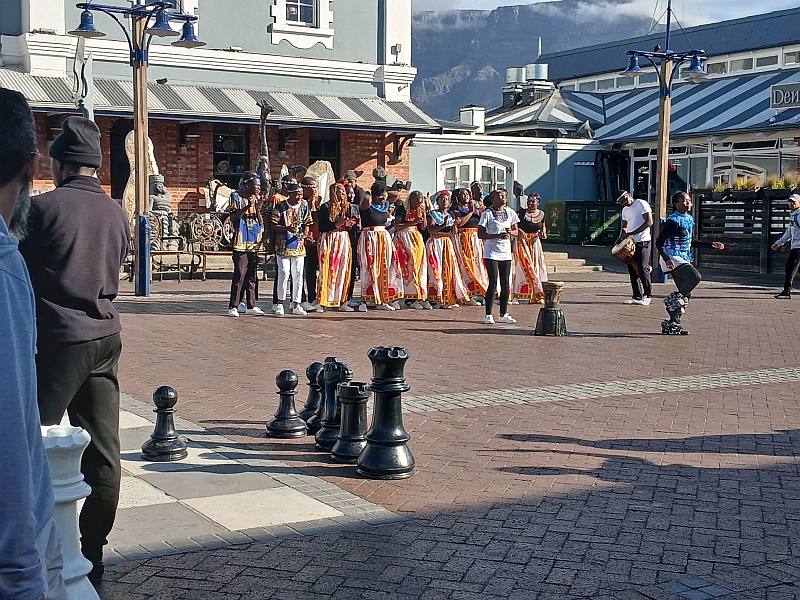
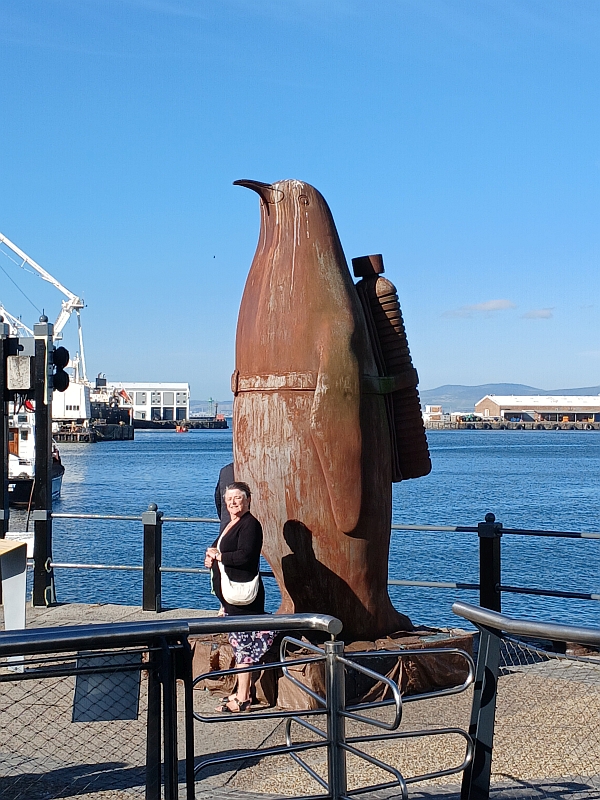
The area was fascinating with a great many shops selling locally-produced items, restaurants providing food from many different areas of Africa as well as around the world, and a variety of street musicians and dancers who created a lively and vibrant atmosphere. There was a beautiful old clock-tower, next to which was a large wooden platform for seals to rest on, and we spent a very happy afternoon exploring the area.
We then returned to a wonderful African food restaurant called Karibu (which is Swahili for 'Welcome') that we had spotted in our reconnaissance trip 2 days earlier. Sitting on the terrace overlooking the harbour, we treated ourselves to a wonderfully indulgent last-night dinner. After our starters of locally-caught mussels and oysters, feeling adventurous I ordered ostrich steaks and Debbie ordered Springbok, and it was at this point that the restaurant's service exceeded all our expectations; the waiter not only advised us that the wine we had chosen would not be ideal with those main courses, but when recommending a different choice he even brought us a glass of each to taste and compare. He was of course absolutely right, so we enjoyed our main courses paired with the perfect wine! Finally, after a delicious dessert, we still had plenty of time to catch the shuttle bus back to the hotel for our last night in Cape Town.
 |
 |
 |
 |
 |
The ancient clock tower |
Seals resting on the wooden platform |
A giant chessboard |
Native dancers |
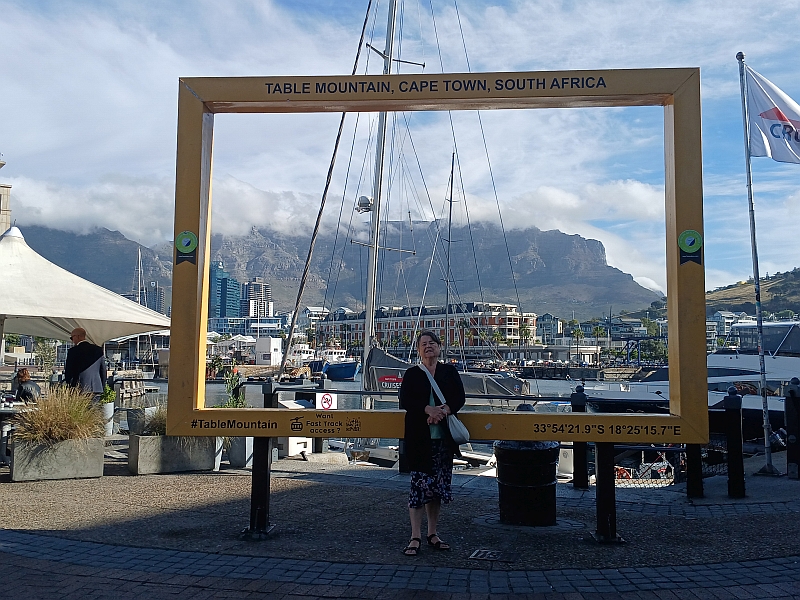
Debbie's been framed |
And with that, our fabulous holiday in Africa was coming to an end. Our journey home was a long one, two days of flying with an overnight stop at Nairobi, but we arrived home on schedule. It was certainly an amazing trip, and one that I would recommend to anyone who loves wild animals or amazing scenery, and I must finish by saying thanks to everybody in our wonderful tour group, including particularly our Tour Guide, Cassie, who found a solution to every little problem which cropped up whilst remaining cheerful and guiding us in the right direction at all times.
| FlickR album of these photos | 1. Livingstone | 2: Botswana | This is Part 3 | |
| Go to Allan's Page | Our Home Page | Holidays Home Page | British Canals Page | Go to Deb's Page |
All pictures on this site are © Allan Jones unless otherwise stated.
