| Go to Allan's Page | Our HOME page | CANALS HOME PAGE | Early canal trips | Go to Deb's Page |
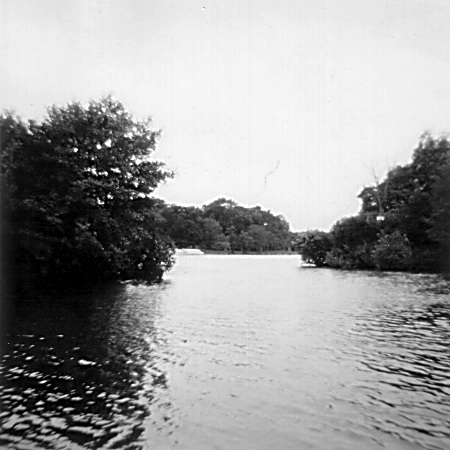
I went to the Norfolk Broads several times with my parents while I was a teenager, but most of the time I didn't have a camera. In 1966 I did have a camera with me, but I only took a few pictures because I couldn't afford the film!
|
|
|
|
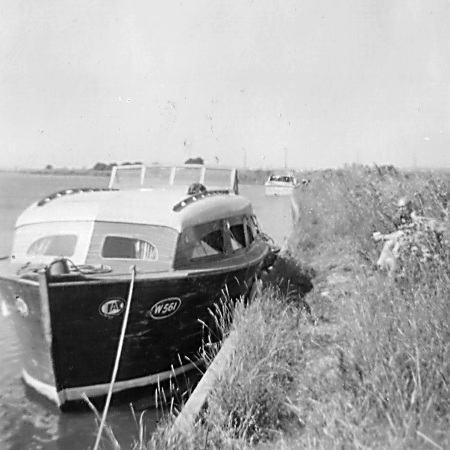
We hired this typical wooden Broads hire cruiser |
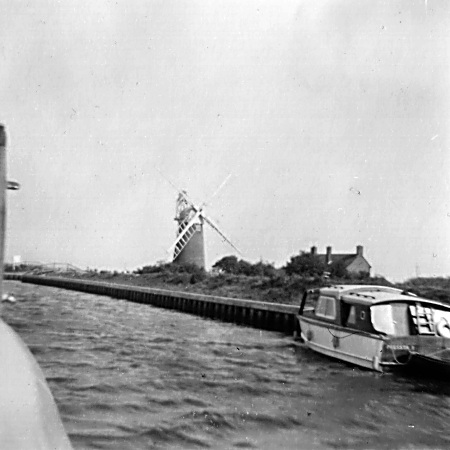
Broadland scene |
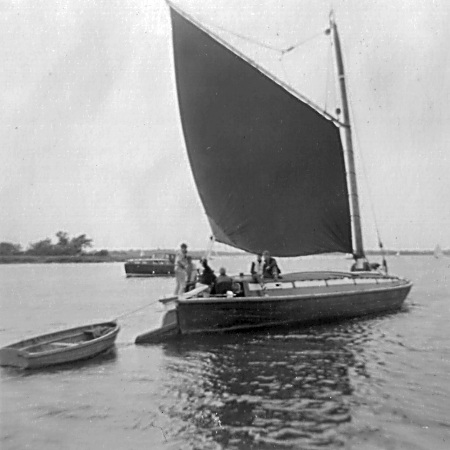
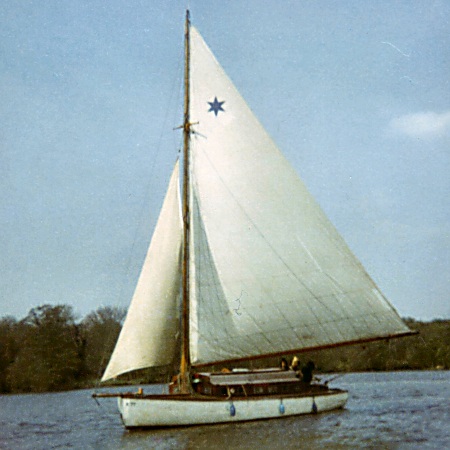
A wherry in full sail |
The boat we hired on that occasion was a fairly typical 4-berth plywood cruiser. Powered by a BMC Vedette petrol engine (as found in the Morris Minor) it was pretty luxurious for the time. The Broads were pretty quiet, you could always moor up for the night where you wanted to, without having to 'breast up' to another boat. There were some larger boats around (see the second picture above) and I just love the picture of the wherry that we saw. Wherries were beautiful boats, designed to be sailed single-handed with just one huge sail; note how much of the sail is high up, to catch the wind that blew over the tree-lined banks upriver.
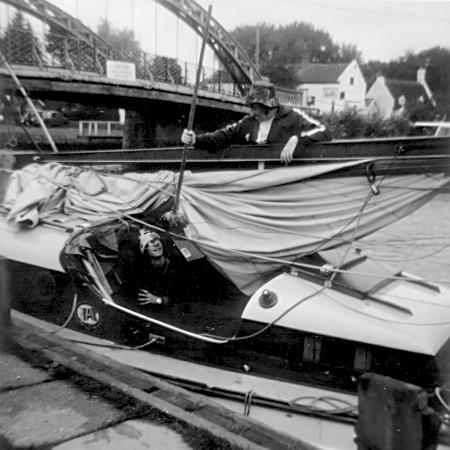
A few years (and a few non-photographic visits) later, in 1971 I hired the 4-berth centre-cockpit sailing boat 'Calypso' for a week from A.D.Truman of Lowestoft. The steering on this boat was weird, she had a vertical tiller sticking up through a slot in the cockpit floor, and you pushed it from side to side to turn the rudder by means of a series of wooden hinged levers that ran under the floor of the rear cabin. When the linkage fell apart and put us aground on the tidal section north of Yarmouth we had to more-or-less dismantle the entire rear cabin to get the floor up and fix the linkages back together again.
When we were attempting to turn down-wind from being moored head-to-wind, by the process of leaving the stern rope tied so the wind would blow the boat right round, the person in charge of the stern rope panicked that we might leave him behind so he untied from the bollard and jumped on board. This meant that we set off straight across the river, and hit some submerged piling on the other side very hard, putting a foot-diameter hole in the hull just below the waterline. We temporarily plugged the hole with the backside of the miscreant ropeman, and sailed on to the next boatyard as quickly as we could. They immediately hoisted Calypso out of the water, and nailed an offcut of plywood over the hole. Within an hour they sent us on our way saying "You've lost your damage-deposit now so you can really go and have fun for the rest of your fortnight". We did!
 |
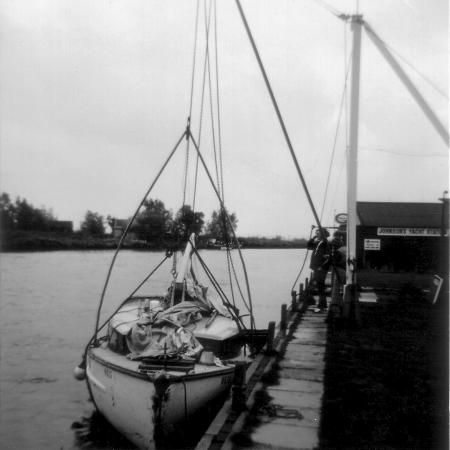 |
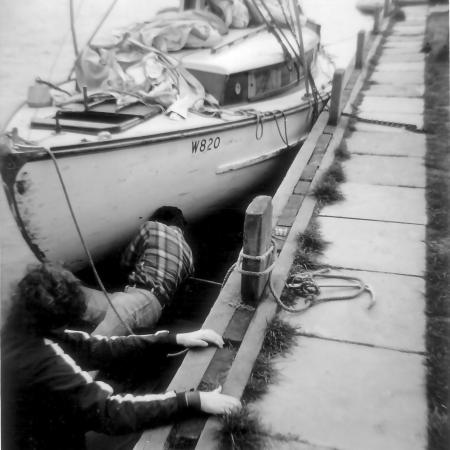 |
Calypso, a wooden centre-cockpit sailing boat |
Hauled out of the water to repair the hole we made |
Nailing a sheet of plywood over the hole |
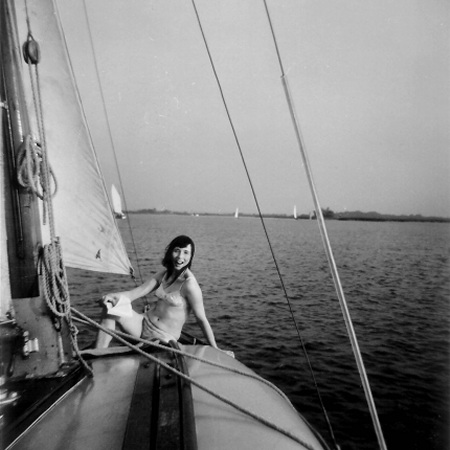 |
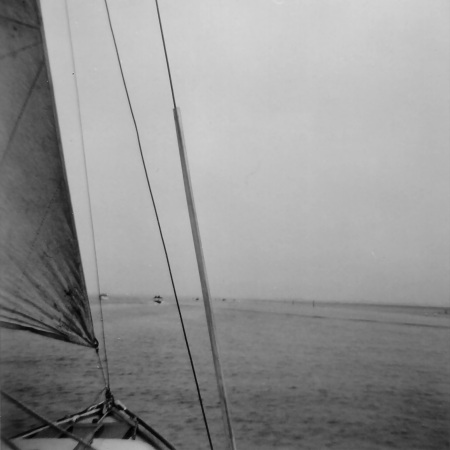 |
 |
The joys of sailing |
Breydon Water - 6 miles long but it dries out at low tide apart from the channel marked by the posts |
Beautiful scenery near Wroxham |
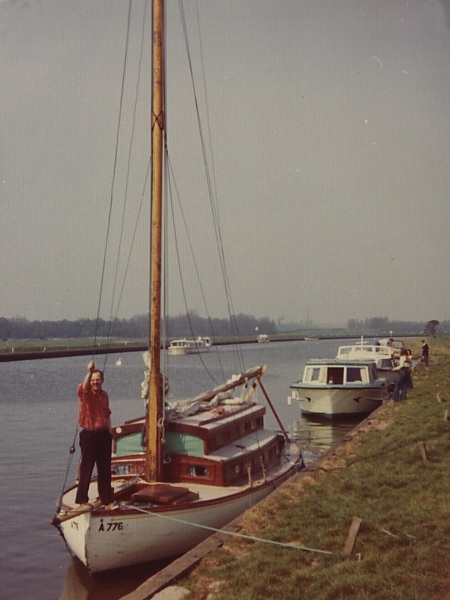
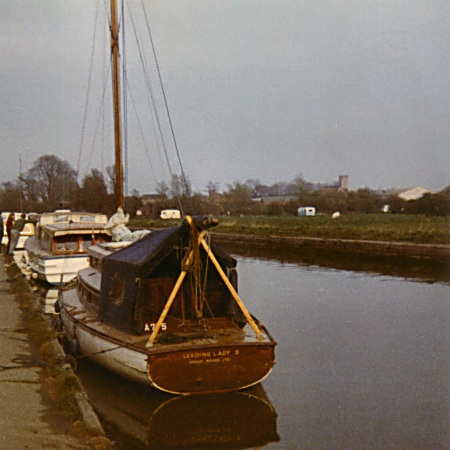
In the early 1970's I spent a number of weeks on the Broads, always around Easter-time when the winds were good and there weren't many motor-cruisers about. Ever year I hired /Leading Lady' class sailing boats from Herbert Woods at Potter Heigham. As the trips I organised became more and more popular with my friends, we hired an increasing number of these beautiful boats every year, until one year 22 of us hired their entire fleet of 5 boats for a week.
 |
 |
 |
We hired the whole fleet of these sailing boats from Potter Heigham |
Sailing nicely on Barton Broad |
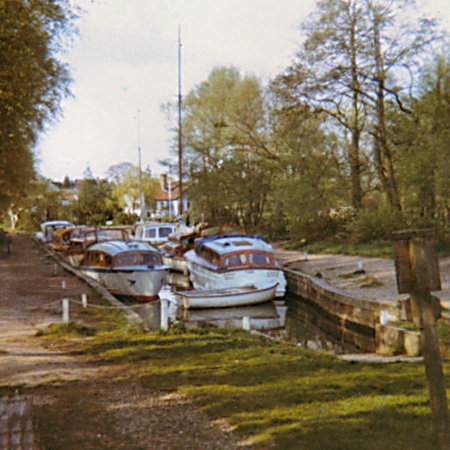
Crowded moorings at Neatishead |
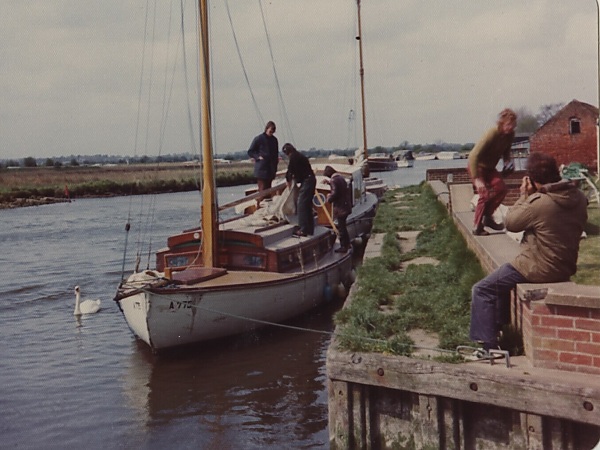
They were wonderful boats, built in the 1920s with loads of mahogany and brass. With 4 or 5 berths they were 35 feet long (plus bowsprit) and weighed 5½ tons. At one point they'd been motorised with 45cc 2-stroke engines, which were mounted in the cockpit side locker driving a propeller beneath that locker - so they could only manage a snail's pace under engine power, and with such a big offset on the prop they tended to go round in circles. When you moored up for the night, to get extra headroom the centre of the roof could be raised by about a foot, with additional side-pieces that filled the gaps to keep the weather out. The boom also had side-pieces attached so that once it was in its crutches the cockpit served as an extra cabin.
 |
 |
 |
After mooring up and lowering the sails ... |
... you raised the roof to give you better headroom inside ... |
... and settled the boom in its crutches to make an extra cabin in the cockpit. |
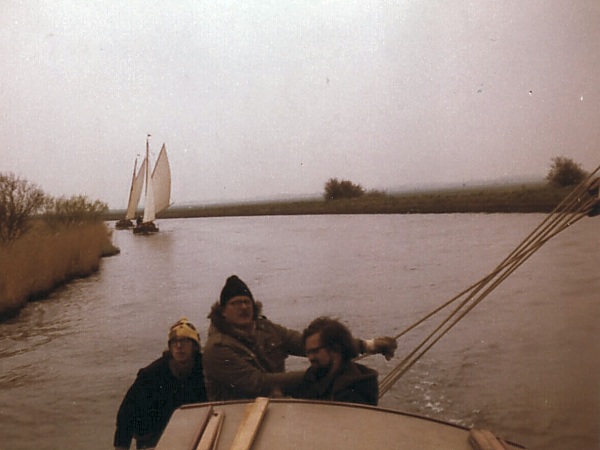
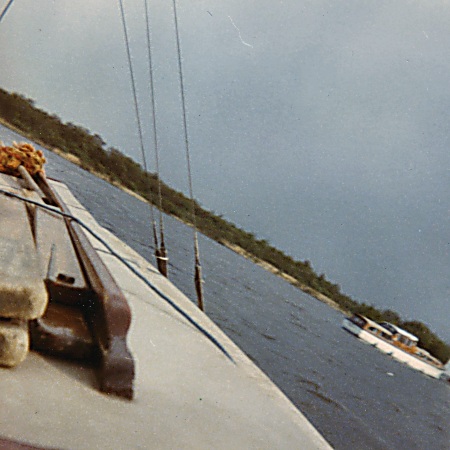
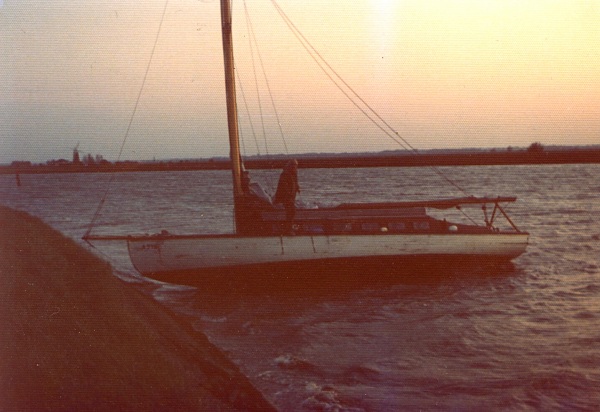
The first year we were disappointed in their sailing performance: in any decent blow they turned straight up into the wind and stopped: a good safety feature for a novice but frustrating for an experienced sailor. We soon realised that they had been built to take a 3-sail rig, but that one foresail was not being supplied to us, so in the next years we brought our own. These were actually Enterprise dinghy foresails, which fitted almost perfectly at the inboard end of the bowsprit. The boats then sailed wonderfully, being so well balanced that you hardly even needed the tiller which previously had needed the full strength of two people to keep straight. This meant that you could heel her over until the rudder was right out of the water, but still keep sailing; one crew member even managed to walk down the side of the boat and stand on the keel while we were sailing well. The only problems of sailing this hard were that water came in the lee-side portholes, and everything inside the cabin fell over (we found the gas-oven swinging from its flexible pipe like a pendulum in the middle of the cabin). Of course we had to remember to take the extra sails off before taking the boat back to the boatyard.We went out in some really strong winds one year. The boatyards had banned all motor cruisers from going out because many were hired by novices who wouldn't be able to cope with the winds, but they were quite happy to let the sailing boats go out with experienced crews. The first afternoon the sails all ripped, so the boatyard brought us a new set. The same thing happened to the new sails the next morning, so they brought us some more at lunchtime. Surely this would be a major problem for the boatyard? Not a bit of it, their insurance company would pay for every set that got ripped - we got through 11 sets of sails in one week for them!
 |
 |
 |
Leading the fleet of the boats that we'd hired |
Sailing really hard on Barton Broad !!! |
Aground at the edge of Breydon Water - half a mile outside the navigation channel |
In the gales we had an unfortunate incident on Breydon Water, which is a tidal lake about 6 miles long and one mile wide. It dries out completely at low tide, apart from a narrow central channel between two rows of marker posts. Heading towards Yarmouth on a falling tide, and carrying a bit too much sail for the conditions, we gybed badly and lost control of the boat which sailed itself out of the main channel and into the mud where it stuck fast. Another boat alerted the authorities, who soon arrived with a strange-looking tugboat. They were worried that with the keel of our boat stuck in the mud, and the boat now lying well over to one side, it might not re-float when the tide came back up. We waited, high-and-dry with mud all around us, for the tide to come in again just a little so they could steer their tugboat on to the mud on the other side of the channel - and sink it! Yes, they just opened some valves and sunk it, driving a set of underwater hydraulic legs deep into the mud. They then stretched a steel hawser across to us, and as the tide rose further they winched us bodily out of the mud and into the main channel. We sailed off leaving them where they were - apparently they would now wait another 12 hours for the tide to go out again, draining the water out of the tugboat, before closing the valves and waiting for the next tide to refloat them. Thank goodness the boat insurance covered the cost of the exercise.
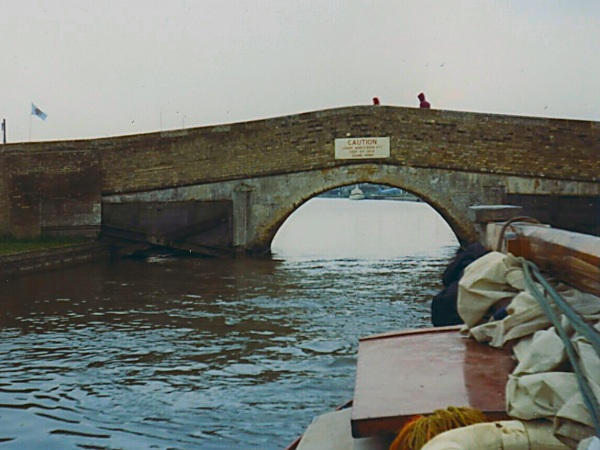
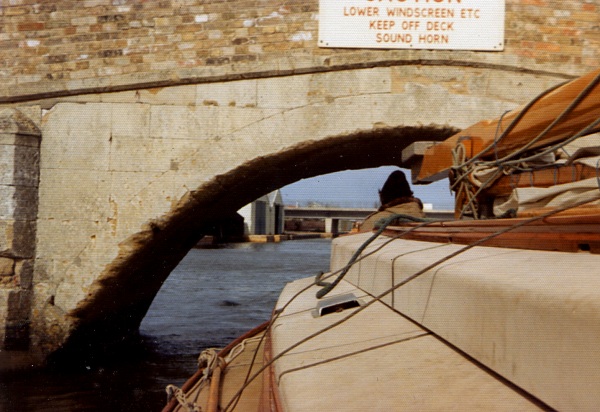
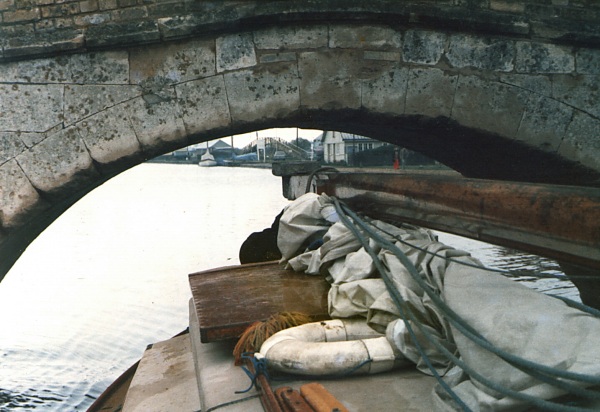
To get through the few bridges, it was necessary to lower the mast. This could be achieved in just a few seconds without lowering the sails on the mast, so you could sail right up to a bridge at full speed, drop the mast at the last minute, drift under the bridge from your own momentum, and raise the mast beyond the bridge to resume sailing before the boat came to a halt. Very impressive when it went well, but a potential disaster if anything went wrong. Here is a sequence to show the shooting of Potter Heigham Bridge, the lowest on the Broads (actually taken on separate occasions, the first photo was taken on a day when we cheated by using the engine, but the remaining three represent genuine 'shooting')
 |
 |
 |
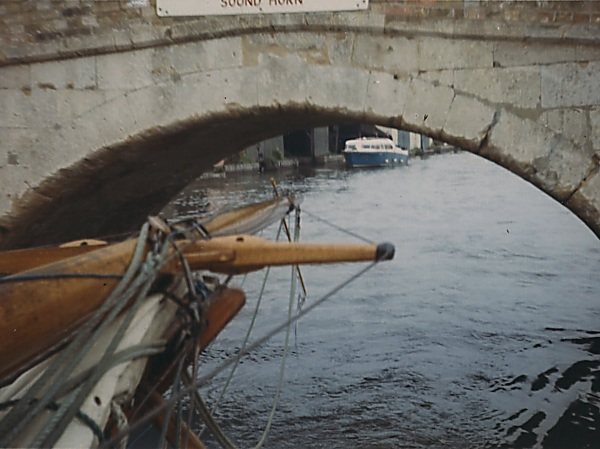 |
Approaching Potter Heigham bridge, we have just lowered the mast and on this occasion we are using the engine |
Starting to pass through the bridge under momentum alone; you can see what a tight fit it is |
Half way through the bridge |
You have to make sure that the end of the mast has cleared the bridge before you raise it or change course. |
Here is a similar sequence negotiating Ludham Bridge which is much easier (although I also confess that we were using the engine all the way through this one)
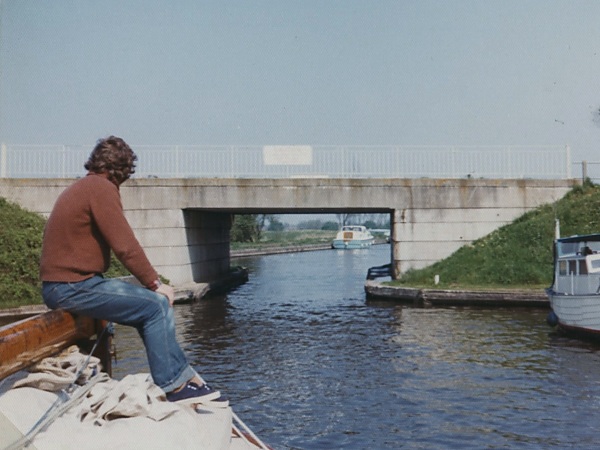 |
 |
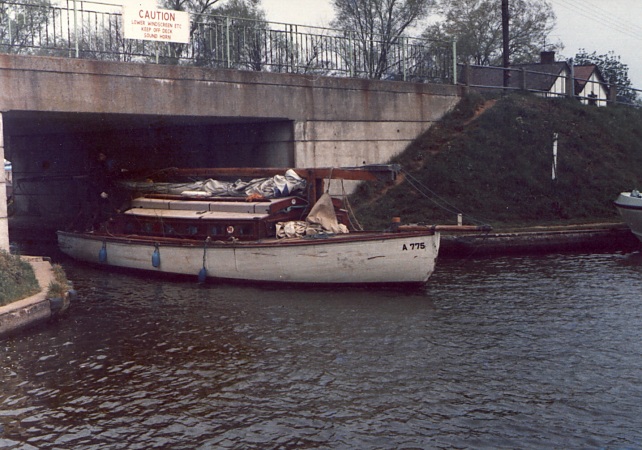 |
Approaching Ludham bridge, we have just lowered the mast |
Half way through the bridge |
Emerging from the bridge |
When there was not much wind you could use the engine, but the engine was slow, noisy, and smelly so we preferred to use the traditional technique of 'quanting' which is similar to punting but with more walking involved. To quant a boat forwards, you use a long pole (called, unsurprisingly, a quant pole) which has a forked shape at one end and a rounded button at the other; standing near the front of the boat you pushed the forked end of the pole down into the water until it touched the bottom, then put your shoulder against the button and walk yourself to the stern of the boat. We used this technique on windless days, and also to get under those bridges which we could not shoot.
 |
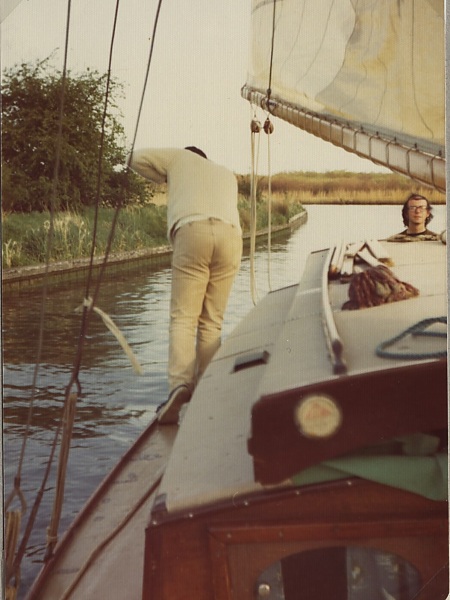 |
Quanting under Acle Bridge |
Quanting well along the open river |
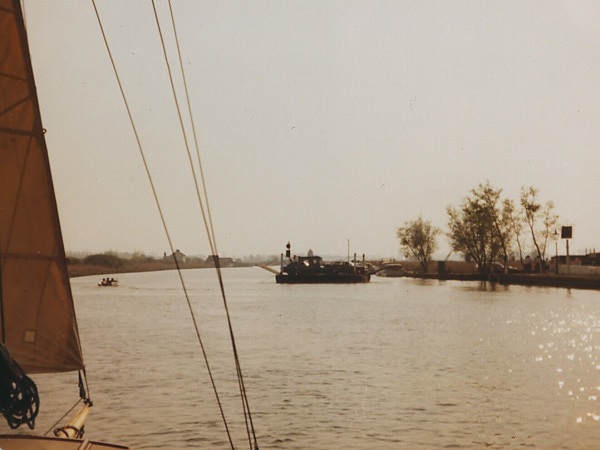
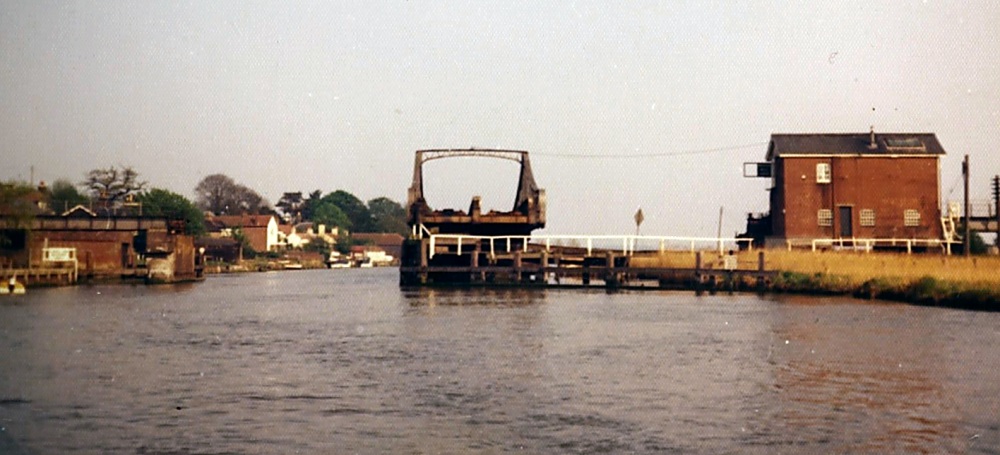
Another interesting bridge was the railway swing bridge at Reedham. With no radios or mobile phones, you would sail up to it, holding something dark such as a duvet or a bath-towel against the sail to show that you wanted to pass. The signalman would wait until the last possible moment before opening the bridge just enough to let your mast through before immediately closing it behind you, unless he was expecting a train in which case you would perform an emergency change of course when the hoped-for gap in the bridge did not appear.
 |
 |
 |
Reedham chain ferry with a full load of cars |
Reedham bridge. Here it is fully opened because a sugar-beet coaster is coming the other way. |
Haddiscoe bridge; it looks high enough to sail under, but if the boat comes upright as the wind drops under the bridge, the tip of the mast can get stuck |
The 'Leading Ladies' were really wonderful old boats, and it was very sad to hear that they had been burned so that their licences could be transferred to a replacement fleet of soulless plastic motor-cruisers (an unwanted side-effect of the licence restrictions which were put into effect when the Broads were declared to be full).
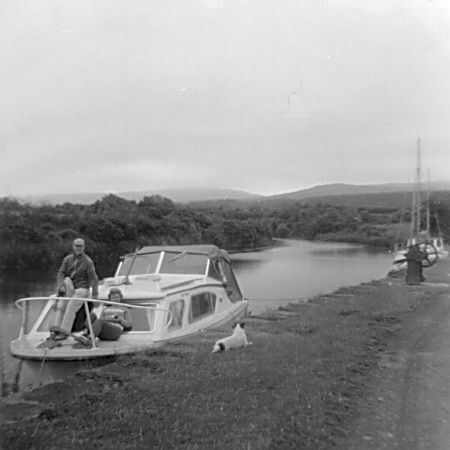
As a change from the Norfolk Broads, in 1971 I went for a week with my parents on the river Shannon. We flew to Dublin and were instantly captivated by the warmth and friendliness of the people we met - although they seemed to use a branch of Logic that was foreign to us. For example, on the way from Dublin to Athlone the coach driver cut right across the road on a blind right-hand bend, and when we asked him how he knew that the road was clear he replied "Well nothing has ever come around that particular corner towards me before!". Then later on we came to a level crossing with one gate open and one gate closed. The keeper opened the one gate for us, explaining that he was 'half-expecting a train', which is actually quite logical because whatever happened he only had to open one gate..
 |
 |
 |
We hired this GRP cruiser on the Shannon |
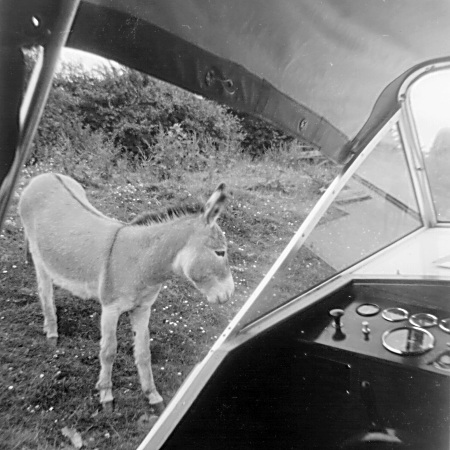
The local wildlife was very interested in us |
Lough Derg is almost 25 miles long |
The trip on the Shannon was wonderful. The highlight of the trip was crossing Lough Derg, which is 25 miles long (as far as Dover-Calais) and can get quite rough in bad weather. The weather was quite kind to us, but on our way back we met a cruiser that hadn't filled his fuel tank enough so although he was OK in calm water, in the slight choppiness of the Lough he kept on sucking air into the system and losing his engine. So we took him in tow back to the head of the Lough, and he offered us a drink to say thanks; my parents didn't drink but I was happy to accept his invitation. At a nearby club he asked me "Do you prefer Scotch Whisky or Irish Whiskey?" When I said I preferred Scotch, he called for a large Scotch Whisky, plus a large Irish Whiskey, plus a pint of Guinness - and the same for himself. He instructed me to sip the Whisky, then the Guinness, then the Whiskey, and the Guinness again, then to say which I preferred. I did so and said I preferred the Whisky, so he told me to try again. He did the same, and when the glasses were empty he called for the same again saying "We'll just keep on going until you prefer the Irish Whiskey", and when I protested he said that his father owned the club so the drinks were all on him. By the time I admitted that I preferred the Irish Whiskey I could barely walk back to the boat, and had to sleep on the floor because every time the boat rocked I fell out of bed. We made a late start the next morning!
My memories of the Shannon are of a simply magical place, and I'm not sure if I'd dare go back in case some of the magic has been lost in the 35 years that have passed since then. However, if you've enjoyed reading this page, you may also enjoy reading my page of memories of the canals from 1969 to 1979
| Go to Allan's Page | Our HOME page | CANALS HOME PAGE | Early canal trips | Go to Deb's Page |
All pictures on this site are © Allan Jones unless otherwise stated
